These are simple and detailed notes for Class 10 AI Unit 2 Advanced Concepts of Modeling in AI Class 10. In this unit, you learn how AI models really learn. You will study AI, Machine Learning, and Deep Learning. You will also study the types of learning, and how a neural network makes a decision.
Good to know: Some basics of modelling were taught in Class 9. Rule-based and learning-based models, and supervised and unsupervised learning, were introduced in Class 9 Unit 1. Data features and data types were covered in Class 9 Unit 2. Here we go deeper, and cover only what is new.
Advanced Concepts of Modeling in AI Class 10 Notes (Unit 2)
What Is Repeated and What Is New?
| Topic | Status | Where to Read |
|---|---|---|
| Rule-based and learning-based models | Revision | Short recap here. Full notes in Class 9 Unit 1 |
| Supervised and unsupervised learning (basic idea) | Revision | Class 9 Unit 1, then deeper here |
| Data features and labels | Revision | Class 9 Unit 2 |
| AI vs ML vs DL | New | This page |
| Reinforcement learning | New | This page |
| Classification, Regression, Clustering, Association | New | This page |
| Deep learning: ANN and CNN | New | This page |
| Neural networks and how AI makes a decision | New | This page |
Revisiting AI, ML and DL
People often use the words AI, ML, and DL as if they mean the same thing. They do not. They are three layers, one inside the other.
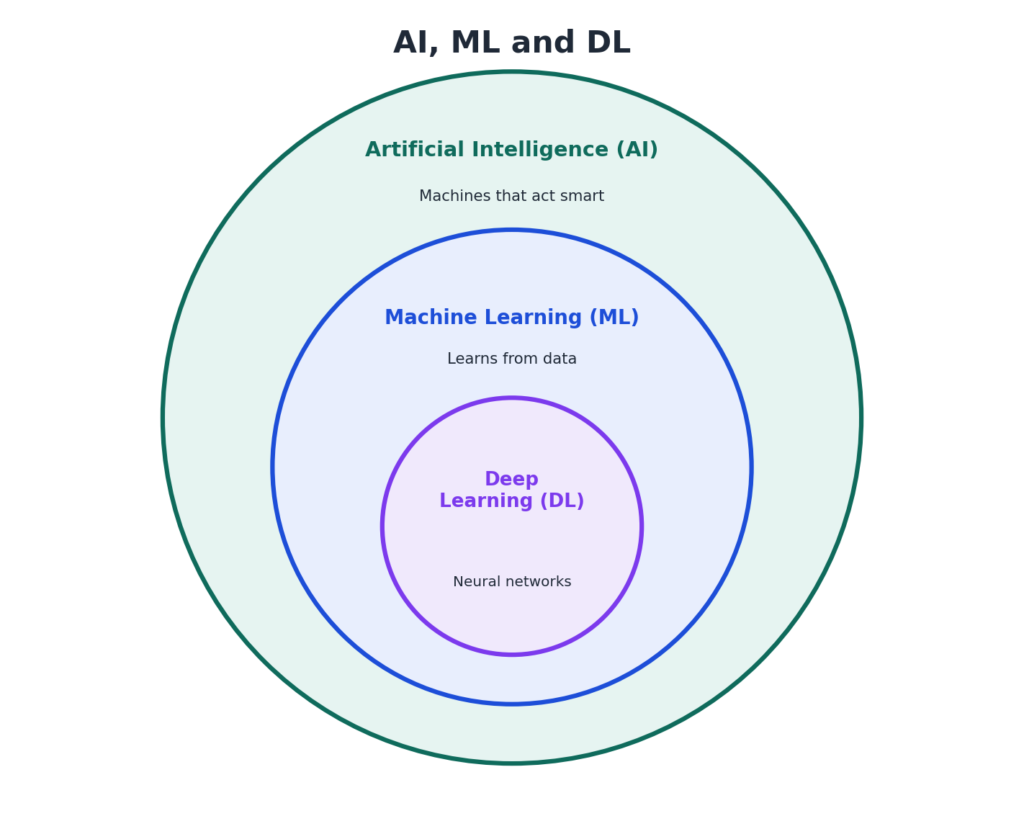
- Artificial Intelligence (AI): The big idea. Any technique that lets a machine copy human intelligence, like thinking, learning, and taking decisions.
- Machine Learning (ML): A part of AI. The machine learns patterns from data, instead of being given fixed rules for everything. It gets better with experience.
- Deep Learning (DL): A part of ML. It uses artificial neural networks with many layers. It can learn very complex things from huge amounts of data.
Simple way to remember: All DL is ML. All ML is AI. But not all AI is ML.
Difference Between AI, ML and DL
| Point | AI | ML | DL |
|---|---|---|---|
| Meaning | Machines that copy human intelligence | A subset of AI that learns from data | A subset of ML that uses neural networks |
| Human help | Can be rule-based and need human programming | Needs less human help once data is given | Finds important features by itself, so needs the least help |
| Data needed | Can work with little data | Needs a good amount of data | Needs a very large amount of data |
| Examples | Virtual assistants, recommendation systems | Spam filter, image tagging | Speech recognition, self-driving cars |
Common Terms Used With Data
Before studying models, learn these words. You will see them again in later units.
| Term | Simple Meaning | Example |
|---|---|---|
| Dataset | A collection of data used to train or test a model. | A table of 1000 student records |
| Feature | One input property of the data (a column). It is used to make the prediction. | Age, marks, attendance |
| Label (Target) | The answer we want the model to predict. | Pass or fail |
| Labelled data | Data where the correct answer is already given. | Photos tagged “cat” or “dog” |
| Unlabelled data | Data with no answers given. | A pile of untagged photos |
| Training data | Data used to teach the model. | 80% of the dataset |
| Testing data | New data used to check the model. | The other 20% of the dataset |
| Algorithm | The set of steps the machine follows to learn. | A method to find patterns |
| Model | The final result after training. It makes predictions on new data. | A spam detector |
Learn more about features and data types in Class 9 Unit 2: Data Literacy.
Types of AI Models: A Quick Recap
AI models are mainly of two types.
- Rule-based approach: A human writes fixed rules. The machine only follows them. It does not learn anything new.
- Learning-based approach: The machine studies data and finds the rules by itself.
The full explanation, with examples, is in Class 9 Unit 1 (Modelling section). In this unit, we study the learning-based approach in detail.
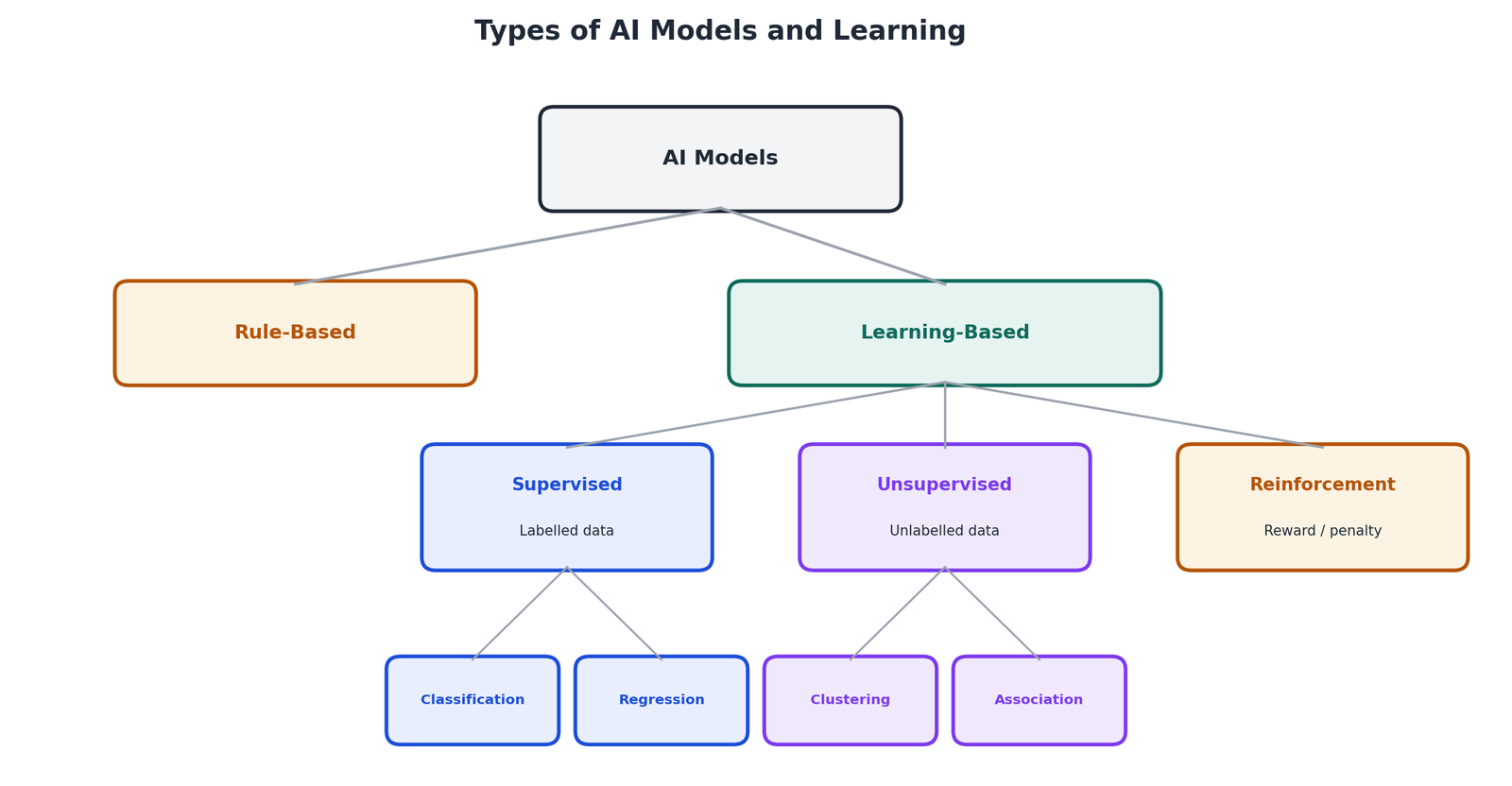
Three Categories of Learning-Based Models
1. Supervised Learning
In supervised learning, the machine is trained with labelled data. It is like learning with a teacher. Each example comes with the correct answer. The model studies many examples, and then predicts the answer for new data.
Example: Currency coins. You show the model many coins. Each coin is labelled with its value, like Rs 1, Rs 2, Rs 5, or Rs 10. The model learns the size, weight, and design of each coin. Later, you give it a new coin, and it tells you the value.
Other examples: Spam email detection, identifying objects in photos, predicting house prices.
Try it: Build your own supervised model with Teachable Machine.
2. Unsupervised Learning
In unsupervised learning, the machine gets unlabelled data. There is no teacher and no correct answers. The model looks at the data and finds hidden patterns or groups on its own.
Example: Supermarket customers. A supermarket has data on what each customer buys, but no labels. An unsupervised model can group customers by their buying habits. It may find a group that buys mostly vegetables, and another group that buys mostly snacks. The store can then offer better deals to each group.
Try it: See an unsupervised idea in action with the Drum Machine experiment from Google.
3. Reinforcement Learning
In reinforcement learning, the machine learns by trial and error. It gets a reward for a good action and a penalty for a bad action. Over time, it learns which actions give the best rewards.
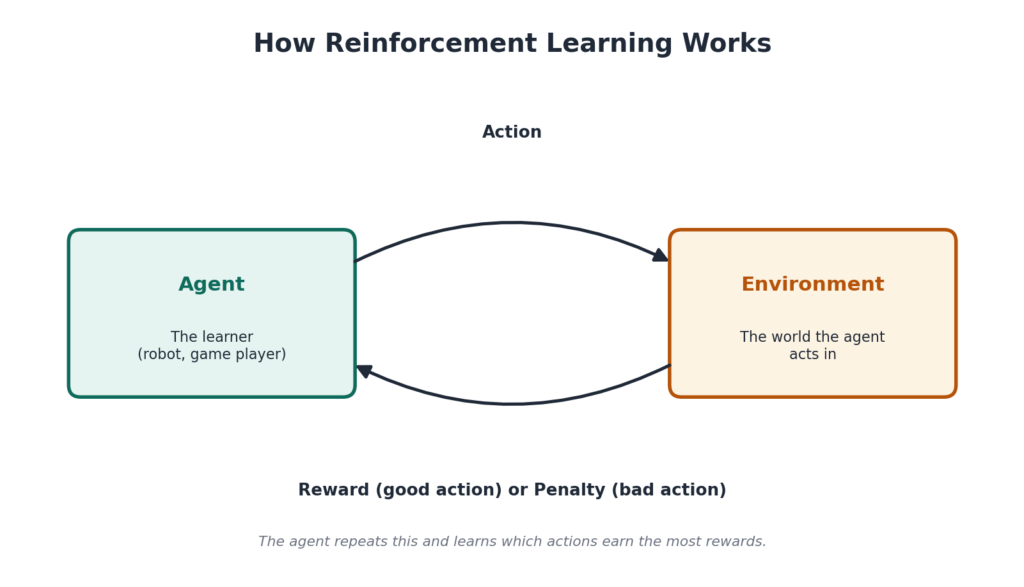
Learn these important words:
- Agent: The learner or decision-maker, like a robot or a game player.
- Environment: The world in which the agent acts.
- Action: What the agent does.
- Reward / Penalty: The feedback the agent gets for its action.
Example: Learning to ride a bicycle. You try to balance. If you stay up, that is a reward. If you fall, that is a penalty. After many tries, you learn the right way. A game-playing AI learns in the same way, by playing again and again.
Other examples: Game-playing AI, robots learning to walk, self-driving cars learning to park.
Summary: Three Categories Compared
| Point | Supervised | Unsupervised | Reinforcement |
|---|---|---|---|
| Data used | Labelled | Unlabelled | No fixed dataset. Learns from feedback |
| Learning style | Learns from correct answers | Finds hidden patterns | Learns by reward and penalty |
| Used when | We want to find a relationship and predict | We want to discover new patterns | We want the machine to learn by trying |
| Example | Spam detection | Customer grouping | Game-playing AI |
Practice: Identify the Learning Type
| Situation | Type |
|---|---|
| A model learns from photos tagged “apple” or “banana”. | Supervised |
| A model groups news articles by topic, with no tags given. | Unsupervised |
| A robot gets +1 for each step it walks and -1 when it falls. | Reinforcement |
| A model predicts tomorrow’s temperature from past weather records. | Supervised |
Sub-Categories of Supervised Learning
Supervised learning has two main kinds of models. The difference is in the kind of answer they give.
1. Classification
A classification model puts data into categories. The answer is a label, like Yes or No, or Cat or Dog. The output is discrete (separate groups).
- Is this email spam or not spam?
- Will the student pass or fail?
- Is the fruit an apple, a mango, or a banana?
2. Regression
A regression model predicts a number. The answer is a continuous value, like a price, a temperature, or a marks score.
- What will be the price of this house?
- What will be tomorrow’s temperature?
- How many marks will a student score?
Discrete and continuous data are explained in Class 9 Unit 2.
| Classification | Regression |
|---|---|
| Predicts a category or label. | Predicts a number. |
| Output is discrete. | Output is continuous. |
| Example: Spam or not spam. | Example: House price. |
Sub-Categories of Unsupervised Learning
1. Clustering
Clustering groups similar items together. The model finds the groups on its own. No one tells it what the groups are.
Example: Grouping customers by shopping habits, or grouping similar photos together.
2. Association
Association finds items or events that often happen together. It finds rules like “people who buy this also buy that”.
Example: A shop finds that customers who buy bread often buy butter too. So it keeps them close, or offers them as a combo.
| Clustering | Association |
|---|---|
| Groups similar data points. | Finds links between items that occur together. |
| Example: Customer groups. | Example: Bread and butter bought together. |
Deep Learning
Deep learning is a part of machine learning. It uses artificial neural networks with many layers. The more layers, the “deeper” the network. It has two common sub-categories.
- Artificial Neural Network (ANN): The basic neural network. It works on general data like numbers and tables.
- Convolutional Neural Network (CNN): A special network made for images. It is used in face recognition and photo tagging. You will study CNN in detail in Class 10 Unit 5 (Computer Vision).
Artificial Neural Networks (ANN)
What Is a Neural Network?
A neural network is an AI model that is inspired by the human brain. Our brain has billions of small cells called neurons. They pass signals to each other. A neural network has many small units, also called nodes or artificial neurons. They are connected and pass information to each other.
Layers of a Neural Network
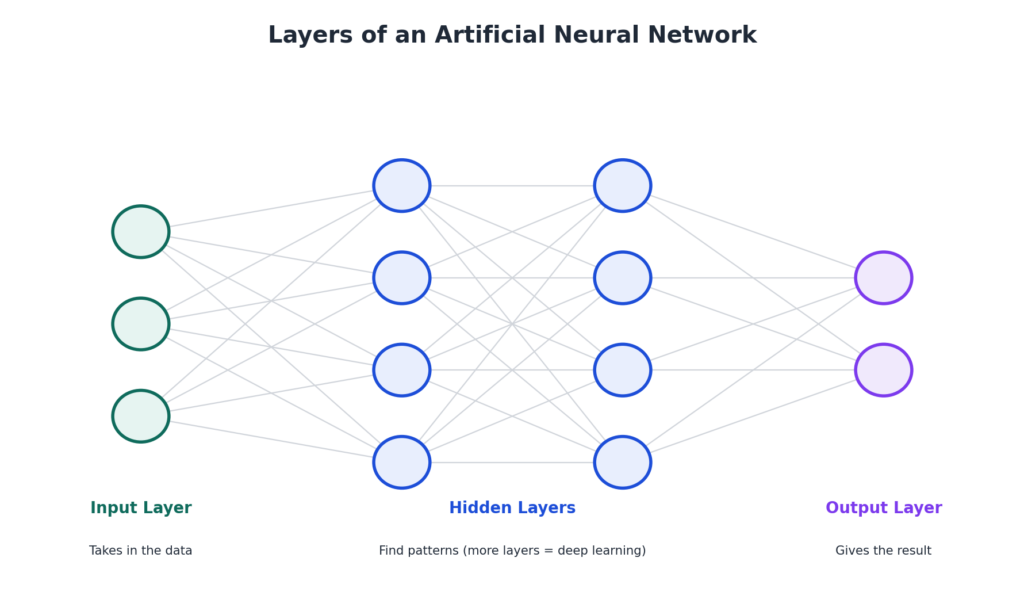
- Input layer: It receives the data. Each node takes one feature. For example, the pixels of an image or the marks of a student.
- Hidden layers: These are in the middle. They do the thinking. They find patterns in the data. A network can have one or many hidden layers.
- Output layer: It gives the final result, like “this is a cat” or “the price is Rs 50 lakh”.
Features of Neural Networks
- They are inspired by the way the human brain works.
- They learn from examples, and get better with more data.
- They can find complex patterns that are hard to describe with simple rules.
- Many nodes work at the same time, so they can handle a lot of data.
Advantages and Disadvantages
| Advantages | Disadvantages |
|---|---|
| Can learn very complex patterns. | Needs a very large amount of data. |
| Works well for images, speech, and text. | Needs a lot of computing power and time. |
| Improves as it gets more data. | Hard to explain why it gave a particular answer. |
How Does AI Make a Decision?
An AI model does not “think” like a human. It does a lot of simple maths very fast. Here is how one node works.
- The node receives some inputs.
- Each input is multiplied by a weight. A weight shows how important that input is.
- All the results are added together.
- If the total is big enough, the node “fires” and passes the signal on. This final check is done by an activation function.
A simple example: Should I take an umbrella? (This is a simplified model for learning.)
Inputs: Is it cloudy? Is humidity high? Is the sun shining? (1 means yes, 0 means no.)
Weights: Cloudy = 0.5, Humidity = 0.4, Sunny = -0.6 (the minus means “sun makes umbrella less needed”).
Rule: If the total is more than 0.5, take an umbrella.
Day 1: Cloudy = 1, Humidity = 1, Sunny = 0. Total = (1 × 0.5) + (1 × 0.4) + (0 × -0.6) = 0.9. Since 0.9 is more than 0.5, the answer is take an umbrella.
Day 2: Cloudy = 0, Humidity = 0, Sunny = 1. Total = 0 + 0 + (1 × -0.6) = -0.6. Since this is less than 0.5, the answer is no umbrella.
In a real network, nobody sets the weights by hand. The network learns the best weights from training data. When it makes a mistake, it adjusts the weights a little, and tries again. This happens thousands of times.
Activities
- Human Neural Network game (class activity idea): Students stand in rows as input, hidden, and output layers. The first row gets a card with some information. Each student passes a signal to the next row, only if their own rule is met. The last row announces the result. This shows how a network passes and combines information.
- TensorFlow Playground: Build and train a small neural network in your browser. Change the layers, nodes, and data, and watch how the model learns. Open TensorFlow Playground
Connection With Other Units
- Once a model is built, we must check how good it is. That is Unit 3: Evaluating Models.
- CNNs are used for image tasks. That is Unit 5: Computer Vision.
- Ethics must be kept in mind while building models. See Class 10 Unit 1.
Quick Revision Points
- DL is inside ML, and ML is inside AI.
- Supervised learning uses labelled data. Unsupervised uses unlabelled data. Reinforcement uses rewards and penalties.
- Supervised: Classification (categories) and Regression (numbers).
- Unsupervised: Clustering (groups) and Association (items bought together).
- Deep learning has ANN and CNN.
- A neural network has input, hidden, and output layers.
- A node multiplies inputs by weights, adds them, and passes the result on.
Multiple Choice Questions
Q1. Which of these is the biggest set?
a) Deep Learning b) Machine Learning c) Artificial Intelligence d) Neural Network
Answer: c) Artificial Intelligence
Q2. Deep learning is a subset of:
a) Machine Learning b) Data Science c) Robotics d) Statistics
Answer: a) Machine Learning
Q3. Which technique uses neural networks with many layers?
a) Rule-based AI b) Deep Learning c) Association d) Clustering
Answer: b) Deep Learning
Q4. The answer that we want a model to predict is called a:
a) Feature b) Dataset c) Label d) Algorithm
Answer: c) Label
Q5. One input property (column) of the data is called a:
a) Label b) Feature c) Model d) Output
Answer: b) Feature
Q6. In which learning does the model learn from labelled data?
a) Supervised b) Unsupervised c) Reinforcement d) None of these
Answer: a) Supervised
Q7. In which learning does the model work on unlabelled data?
a) Supervised b) Unsupervised c) Reinforcement d) Rule-based
Answer: b) Unsupervised
Q8. Learning through reward and penalty is called:
a) Supervised learning b) Unsupervised learning c) Reinforcement learning d) Rule-based learning
Answer: c) Reinforcement learning
Q9. In reinforcement learning, the learner is called the:
a) Environment b) Agent c) Label d) Node
Answer: b) Agent
Q10. A model that decides whether an email is spam or not spam is a:
a) Regression model b) Clustering model c) Classification model d) Association model
Answer: c) Classification model
Q11. A model that predicts the price of a house is a:
a) Classification model b) Regression model c) Clustering model d) Association model
Answer: b) Regression model
Q12. Grouping customers by their shopping habits, without labels, is:
a) Regression b) Classification c) Clustering d) Reinforcement
Answer: c) Clustering
Q13. “People who buy bread also buy butter” is an example of:
a) Association b) Classification c) Regression d) Evaluation
Answer: a) Association
Q14. Which of these is a sub-category of supervised learning?
a) Clustering b) Association c) Regression d) Reinforcement
Answer: c) Regression
Q15. Which of these is a sub-category of unsupervised learning?
a) Classification b) Regression c) Clustering d) CNN
Answer: c) Clustering
Q16. ANN stands for:
a) Advanced Neural Network b) Artificial Neural Network c) Automatic Node Network d) Applied Neural Node
Answer: b) Artificial Neural Network
Q17. Which neural network is mainly used for images?
a) ANN b) CNN c) Both are never used for images d) None of these
Answer: b) CNN
Q18. Which layer of a neural network receives the data?
a) Hidden layer b) Output layer c) Input layer d) Middle layer
Answer: c) Input layer
Q19. Which layer gives the final result?
a) Input layer b) Hidden layer c) Output layer d) First layer
Answer: c) Output layer
Q20. In a node, a weight shows:
a) The name of the data b) How important an input is c) The number of layers d) The size of the dataset
Answer: b) How important an input is
Q21. Which tool lets you build and train a neural network in the browser?
a) Teachable Machine b) TensorFlow Playground c) Quick Draw d) Semantris
Answer: b) TensorFlow Playground
Q22. Which of these is a disadvantage of neural networks?
a) They cannot learn complex patterns b) They need large amounts of data and computing power c) They never improve d) They work only with text
Answer: b) They need large amounts of data and computing power
Assertion and Reason Questions
Choices: (a) Both A and R are true and R explains A. (b) Both A and R are true but R does not explain A. (c) A is true but R is false. (d) A is false but R is true.
Q23. Assertion (A): Deep learning is a subset of machine learning.
Reason (R): Deep learning uses neural networks with many layers.
Answer: (b) Both are true, but R describes what DL is. It does not explain why DL is a subset of ML.
Q24. Assertion (A): Clustering is a supervised learning technique.
Reason (R): Clustering works on unlabelled data.
Answer: (d) A is false, because clustering is an unsupervised technique. R is true, because clustering works on unlabelled data.
Case-Based Question
An online shop wants to use AI. It has three tasks. Task 1: predict next month’s sales amount. Task 2: group its customers into similar groups, for targeted offers. Task 3: decide whether a customer review is positive or negative, using many reviews already marked positive or negative.
- Which type of model fits Task 1? Answer: Regression (supervised learning), because the answer is a number.
- Which type of model fits Task 2? Answer: Clustering (unsupervised learning), because there are no labels.
- Which type of model fits Task 3? Answer: Classification (supervised learning), because reviews are labelled and the answer is a category.
Short Answer Questions
- Differentiate between AI, ML, and DL.
- What is a dataset? What is the difference between a feature and a label?
- What is supervised learning? Give one example.
- What is unsupervised learning? Give one example.
- What is reinforcement learning? Name its four main terms.
- Differentiate between classification and regression.
- Differentiate between clustering and association.
- What is a neural network? Name its three layers.
- What is the function of the hidden layer?
- Name two advantages and two disadvantages of neural networks.
- What is the difference between ANN and CNN?
- What is a weight in a neural network?
Long Answer Questions
- Explain AI, ML, and DL with a diagram. How are they related to each other?
- Explain the three categories of learning-based models: supervised, unsupervised, and reinforcement learning, with examples.
- Explain the sub-categories of supervised and unsupervised learning, with one example each.
- What is a neural network? Explain its layers with a diagram.
- Explain how an AI model makes a decision, with a simple example of inputs, weights, and output.
Keep Learning
You have finished Unit 2. Next, learn how to check if a model is good, in Unit 3: Evaluating Models. For all units, visit the Class 10 AI Notes page.