These are simple and detailed notes for Class 9 AI Unit 1. This unit has three parts. Part one is AI Reflection. Part two is AI Project Cycle. Part three is AI Ethics. Let us go through each part step by step, in easy words.
AI Reflection, Project Cycle and Ethics Class 9 Notes (Unit 1)
Part 1: AI Reflection
What is AI?
AI means Artificial Intelligence. It has two words. “Artificial” means something made by humans, not found in nature. “Intelligence” means the power to learn, think, and use knowledge to solve problems.
So AI is when a machine can think, learn, and take decisions like a human. A normal computer only follows fixed instructions. It cannot learn on its own. But an AI machine can look at data, find patterns, and improve itself over time. This is what makes AI special.
AI does not mean robots only. AI can be a simple app on your phone. AI can be a website. AI can even be a small chip inside a washing machine. Anything that can sense, think a little, and act, can use AI.
How is Human Intelligence Different from Machine Intelligence?
Humans learn from experience, feelings, and the five senses. Humans can also use common sense. Machines do not have feelings or common sense. Machines learn only from the data we give them.
For example, a human child learns to recognise a cat after seeing a few cats. A machine may need thousands of cat photos before it can recognise a cat correctly. This shows that human learning and machine learning work in different ways, even though the goal looks similar.
Where Do We See AI in Daily Life?
AI is already a big part of our daily life. Here are some common examples.
- Face unlock on phones: The camera checks your face and unlocks the phone only if it matches your stored data.
- Voice assistants: Apps like Siri, Alexa, and Google Assistant listen to your voice, understand your words, and answer you.
- Fraud detection: Banks use AI to catch fake or unusual transactions and protect your money.
- Medical scans: AI helps doctors read X-rays and scans faster, and spot problems early.
- Recommendation systems: Apps like YouTube and Netflix use AI to suggest videos and shows you may like.
- Traffic and maps: Apps like Google Maps use AI to find the fastest route and predict traffic.
- Spam filters: Email apps use AI to detect and block spam mails automatically.
- Smart home devices: Smart lights and thermostats can learn your habits and adjust themselves.
Fun Activity: AI Games
You can play these small games to understand how each domain of AI actually feels in real life.
- Game 1 (Data): Rock, Paper, Scissors AI game. The AI tries to guess your next move using past data. Play here
- Game 2 (NLP): Semantris, a word game by Google, based on Natural Language Processing. Play here
- Game 3 (Computer Vision): Quick Draw, a drawing game by Google, based on Computer Vision. Play here
You can also try the LUIS demo, where you type a sentence about lighting, and the system understands it and adjusts a virtual house. Try it here
Three Domains of AI
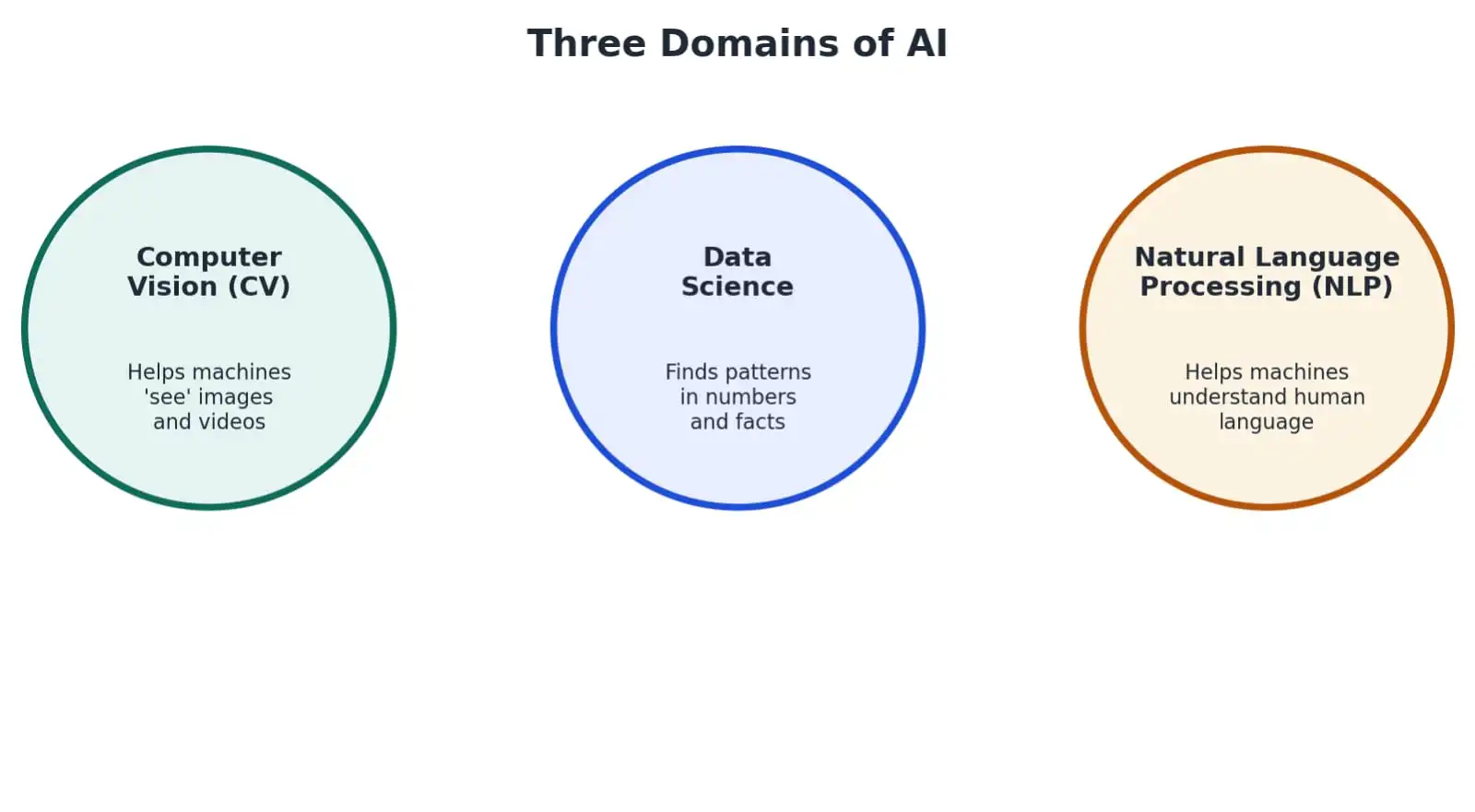
Almost every AI project falls under one or more of three main areas. These are called domains of AI. Knowing these domains helps us understand what kind of data and method a project needs.
1. Computer Vision (CV)
Computer Vision helps a machine “see” the world. It studies pictures and videos and pulls out useful information from them. It can spot a face, a number plate, or an object in an image.
Examples: Face unlock, self-driving cars reading the road, and apps that scan documents.
2. Data Science (Data for AI)
This domain uses numbers, facts, and figures. It studies large sets of data using maths and statistics to find hidden patterns. These patterns help AI make good guesses about the future.
Examples: Predicting weather, forecasting sales, and detecting fraud in bank transactions.
3. Natural Language Processing (NLP)
NLP helps a machine understand human language. It works with both written text and spoken words. It can read a sentence, understand its meaning, and even reply back.
Examples: Google Translate, chatbots on shopping websites, and voice typing.
Advantages and Disadvantages of AI
Like every technology, AI has both good and bad sides. It is important to think about both.
| Advantages | Disadvantages |
|---|---|
| Saves time by doing repeated tasks quickly. | Can replace some jobs done by humans. |
| Reduces human error in many tasks. | Needs a lot of data, which can raise privacy concerns. |
| Works non-stop, day and night. | Can show bias if trained on unfair data. |
| Helps solve big problems in health, farming, and education. | Can be expensive to build and maintain. |
Class activity idea: Try a balloon debate. Split the class into two teams. One team argues that AI is helpful for society. The other team argues that AI can be harmful. This helps you see both sides clearly.
Part 2: AI Project Cycle
What is the AI Project Cycle?
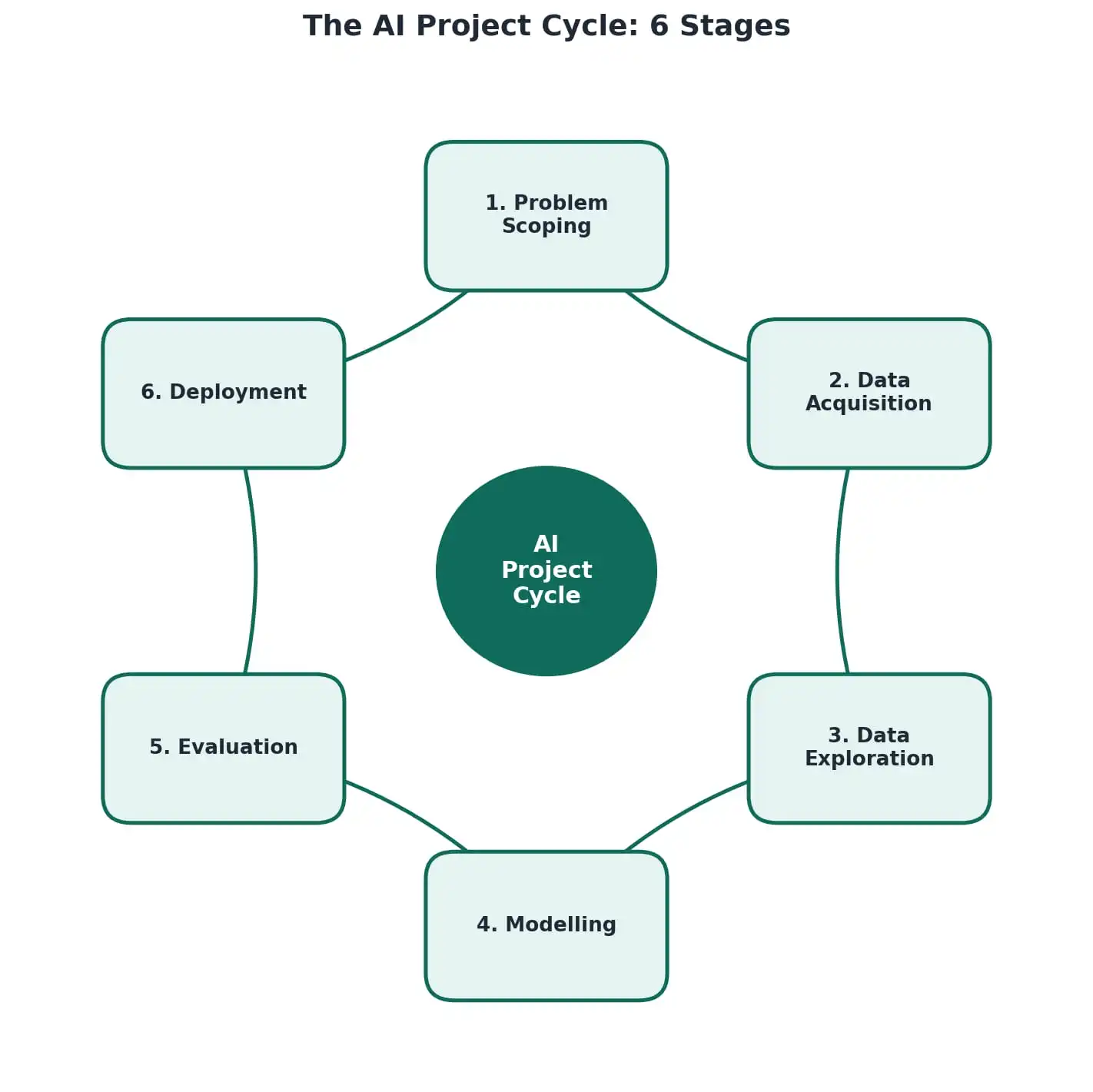
The AI Project Cycle is a set of steps. We follow these steps in order to solve a real problem using AI. It has six stages.
- Problem Scoping
- Data Acquisition
- Data Exploration
- Modelling
- Evaluation
- Deployment
It is called a “cycle” and not a straight line, because we often go back to an earlier step. For example, if our model does not work well at the Evaluation stage, we may go back to Data Acquisition and collect more data. This back-and-forth continues until the model works well.
Example: A Farmer’s Pest Problem
Let us understand the whole cycle using one simple example. A farmer has a cotton field. Pests are damaging his crop every year, and he is losing money. Let us see how AI can help him, step by step.
- Step 1 (Problem Scoping): We study the problem closely. We find out which pest is damaging the crop, and when this usually happens.
- Step 2 (Data Acquisition): We collect data like photos of pests, weather data, and past pesticide records.
- Step 3 (Data Exploration): We study this data using charts. We check which season has the most pest attacks.
- Step 4 (Modelling): We build an app that can look at a photo and tell which pest it is.
- Step 5 (Evaluation): We test the app on new pest photos to see how correct it is.
- Step 6 (Deployment): We give the finished app to farmers, so they can use it in their own fields.
1. Problem Scoping
Problem Scoping is the first and most important stage. It means understanding a problem clearly before trying to solve it. Many AI projects fail simply because the problem was not understood properly at the start.
In this stage, we ask a lot of questions. We try to understand who is affected, what exactly is going wrong, where it happens, and why it matters. This careful thinking saves a lot of time later.
The 4Ws Problem Canvas
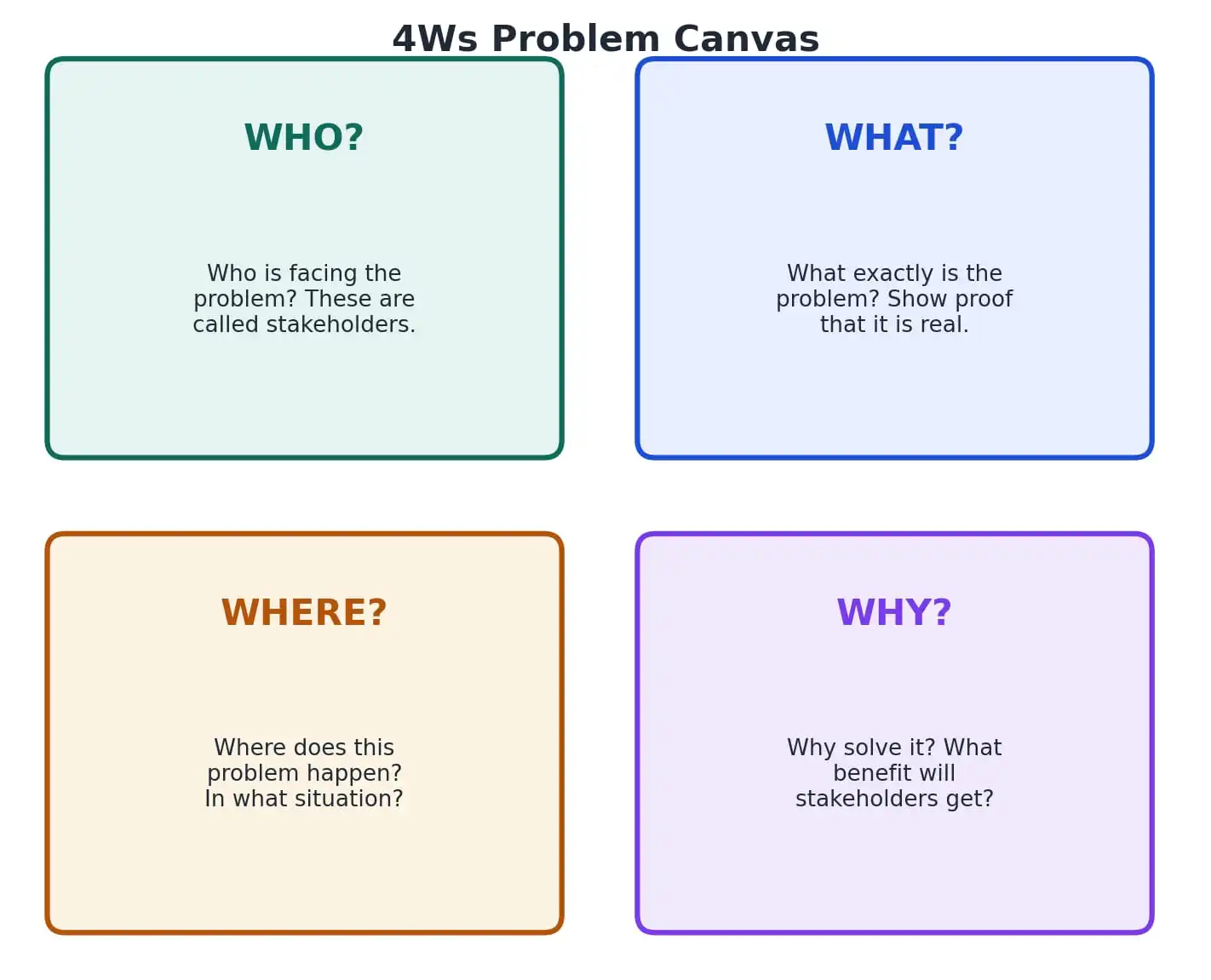
The 4Ws Canvas is a simple tool that helps us study a problem from four different sides. These are Who, What, Where and Why. Filling this canvas gives us a full and clear picture of the problem.
- Who: Who is facing this problem? These people are called stakeholders. There can be more than one type of stakeholder. In the farmer’s example, the stakeholders are the farmer, his family, and even the buyers of the crop.
- What: What exactly is the problem? Here we also write proof that the problem is real, such as a news report, a survey, or personal experience.
- Where: Where does this problem happen? This could be a place, like a field, or a situation, like the rainy season.
- Why: Why should we solve this problem? What benefit will the stakeholders get if the problem is solved?
Problem Statement Template
After filling the 4Ws Canvas, we write a short summary of the whole problem. This summary is called the Problem Statement Template. It usually looks like this:
“Our [stakeholder] has a [problem], which happens at [place/situation], and if it is solved, it will help by giving [benefit].”
This one sentence puts all the important points together in one place. It becomes very useful when the team discusses the project later, or explains it to someone new.
Decision Matrix
Sometimes a class or a team has many problem ideas, not just one. A decision matrix helps the team pick the best idea among all of them.
To make a decision matrix, we list all our problem ideas in rows. Then we list important points in columns, such as cost, time needed, number of people affected, and how easy it is to solve. We give each idea a score for every point, add up the scores, and pick the idea with the highest total score.
System Maps
A system map is a simple diagram made of boxes and arrows. It shows how different data features are connected to each other and to the main problem. For example, in the farmer’s problem, a system map may connect “rainfall”, “temperature” and “pest attack” with arrows, showing how one affects the other.
System maps help us plan our data collection better, because we can see clearly which data points actually matter for our problem.
2. Data Acquisition
Once the problem is clearly understood, the next step is Data Acquisition. This means collecting correct and reliable data that our AI model can learn from. Data can be in many forms, such as text, numbers, photos, video, or audio.
Types of Data Based on Use
- Training data: This is the main data used to teach the AI model. The model studies this data again and again to learn patterns.
- Testing data: This is new data that the model has never seen before. We use it later to check if the model actually learned correctly, or if it just memorised the training data.
Types of Data Based on Source
- Primary data: Data collected directly by us, for our own project, such as a class survey.
- Secondary data: Data already collected by someone else, which we use for our project, such as government reports.
Ways to Collect Data
- Surveys: Asking a set of questions to a group of people.
- Interviews: Talking to a person directly to understand their views in detail.
- Observation: Watching and noting down things carefully over time.
- Cameras and sensors: Devices that automatically collect photos, videos, sound, or measurements like heat and motion.
- Web scraping: Using a program to automatically collect data from websites.
- APIs: A method where two different apps or systems share data with each other directly.
- Open government data: Free data shared by the government on public websites, such as data.gov.in.
Rules for Good Data
Not all data is useful. Good data usually follows these three rules:
- Relevant: The data should closely match the problem we are solving.
- Authentic: The data should be true, correct, and not fake.
- Sufficient: There should be enough data for the model to learn properly. A small amount of data can lead to wrong results.
We should always collect data from trusted sources. We should never use someone else’s private data without their permission. This point connects directly to AI Ethics, which we will study later in this unit.
3. Data Exploration
Collecting data is not enough. We also need to study and understand it properly. This is done in the Data Exploration stage.
Here, we arrange the raw data neatly and study it using graphs and charts. This helps us find patterns, trends, and even mistakes in the data before we move further. If we skip this step, our AI model may learn from messy or wrong data, and give poor results later.
Common Ways to Visualise Data
- Bar and column charts: Good for comparing different groups, such as pest attacks in different months.
- Line charts: Good for showing change over time, such as rainfall over a year.
- Pie charts: Good for showing parts of a whole, such as percentage of each pest type found.
- Scatter plots: Good for showing the relationship between two things, such as temperature and pest count.
This stage also tells us clearly if our data is good enough for the project, or if we need to go back and collect more or better data.
4. Modelling
Modelling means building the actual AI model using the data we have studied. This is the stage where the machine truly starts to “think” based on data. There are two main ways to build a model.
Rule-Based Approach
In this approach, the developer sets fixed rules by hand. The machine simply follows these rules, every single time. It does not learn anything new by itself.
Example: A rule like “if temperature is above 40 degrees, mark it as very hot” is a fixed rule. It works the same way for every case, even if the situation changes slightly.
Limitation: If a new, unusual case comes up that the rule does not cover, the model may give a wrong answer, because it cannot adjust on its own.
Learning-Based Approach
In this approach, we do not write fixed rules. Instead, we give the machine a large amount of data, and it studies this data to find patterns by itself. This approach has two main types.
- Supervised Learning: The data has labels, which means the correct answer is already given along with each example. The model studies these labelled examples and learns to predict the answer for new, unlabelled data. Example: Showing the model many photos labelled “cat” or “dog” so it can later tell a new photo apart.
- Unsupervised Learning: The data has no labels at all. The model looks at the data and groups similar items together on its own, without being told the answer. Example: Grouping shop customers into sets, based only on their shopping habits, without telling the model what the groups should be.
Simple way to remember: In Rule-Based, humans give the rules. In Learning-Based, the machine finds the rules itself, using data.
5. Evaluation
Evaluation means checking carefully if the model actually works well. We never test a model only on the same data it was trained on, because it may have simply memorised the answers. Instead, we always test it on testing data, which is new to the model.
Key Terms in Evaluation
Suppose an AI model is built to predict forest fires. Every time it makes a prediction, we compare it with what actually happened in real life. This gives us four possible results.
- True Positive: The model says “yes, there is a fire”, and there really is a fire.
- True Negative: The model says “no fire”, and there really is no fire.
- False Positive: The model says “yes, there is a fire”, but there is actually no fire. This is a false alarm.
- False Negative: The model says “no fire”, but there is actually a fire. This is a missed case, and often the most dangerous mistake.
All four results are noted together in a simple table called the Confusion Matrix. It gives us a full picture of where the model is doing well, and where it is making mistakes.
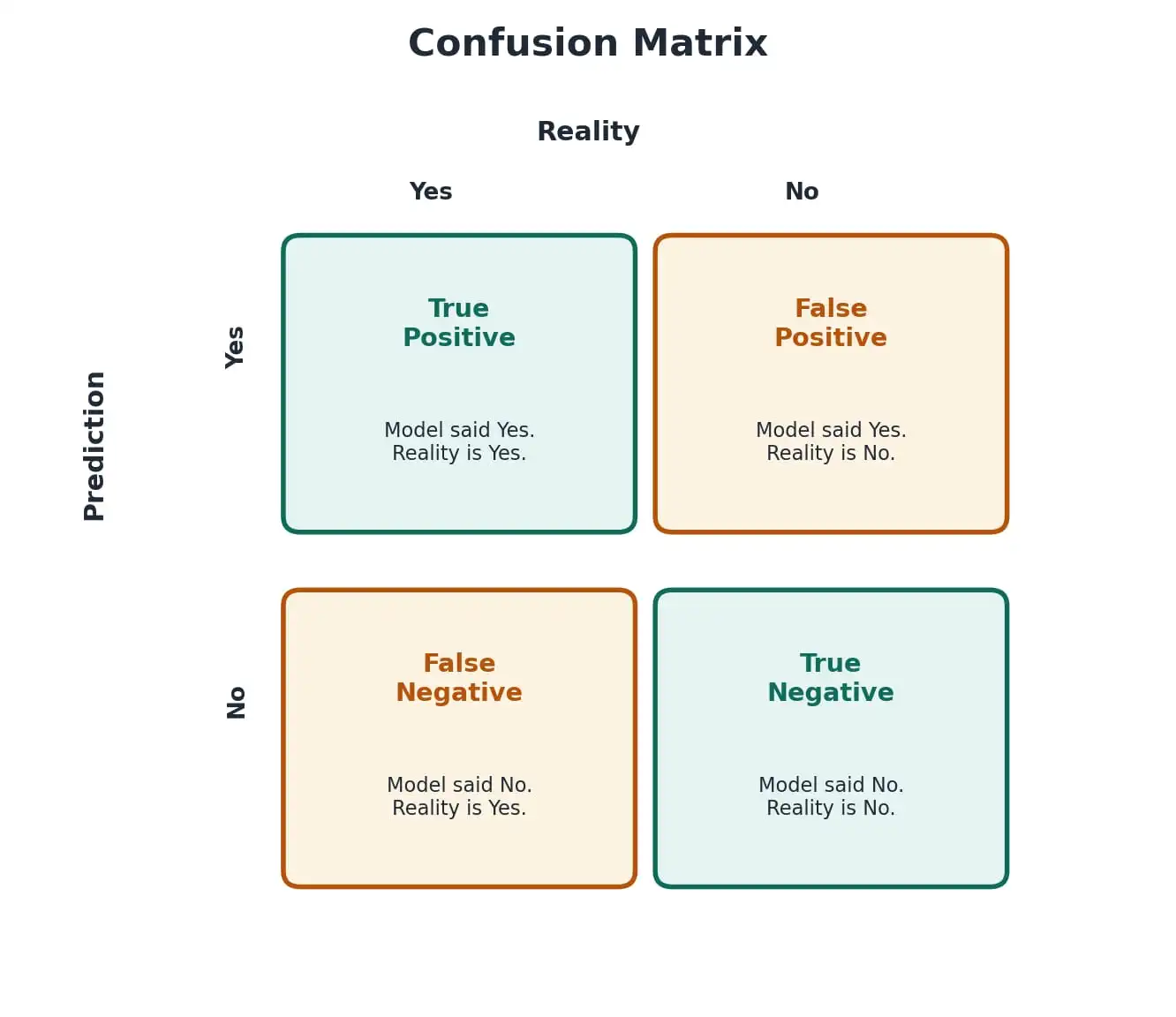
From the confusion matrix, we can also calculate how accurate a model is. In simple words, accuracy tells us out of all the predictions made, how many were actually correct. A model with high accuracy is more reliable to use in real life.
6. Deployment
Deployment is the final stage of the AI Project Cycle. Here, the finished and tested AI model is placed into the real world, so that real people can actually use it.
Deployment usually happens in three parts:
- Testing and validation: A final check to make sure the model works correctly before it goes live.
- Integration: Connecting the model to an app, website, or device, so people can use it easily.
- Monitoring: Keeping an eye on the model after launch, and updating it from time to time, because real-world data can change.
Example: In the farmer’s pest problem, once the model correctly identifies pests, the app is deployed on farmers’ mobile phones. But even after this, the developers keep checking the app and improving it, based on real feedback from farmers.
Part 3: AI Ethics
Why Do We Need AI Ethics?
AI is a very powerful tool. It can help doctors, farmers, and businesses in big ways. But this same power can also be misused, or can cause harm by mistake. AI Ethics is the set of ideas that guide us on how AI should be built and used responsibly, so that it helps people instead of harming them.
Ethics vs Morals
Ethics and morals sound similar, but they are not exactly the same thing.
| Morals | Ethics |
|---|---|
| Personal beliefs about right and wrong. | Rules set by society or a profession. |
| Can be different for every single person. | Mostly the same rules apply to everyone in a group. |
| Example: I personally believe honesty is important. | Example: A shop must never sell spoiled food to customers. |
Class activity idea: Try the Moral Machine website. It shows tricky real-life situations for self-driving cars and asks you to choose what the car should do. This helps you understand how difficult ethical decisions can be for AI. Visit Moral Machine
AI and Personal Data
Most AI apps collect our personal data to work properly. This can include our name, photos, location, voice, and even our daily habits. AI Ethics tells us clearly how this kind of data should be handled.
- Always protect people’s privacy.
- Never misuse anyone’s personal data.
- Collect data only with the person’s clear permission.
- Use the data only for the purpose it was collected for, not for anything else.
- Store data safely, so it cannot be stolen or leaked.
Main Issues in AI Ethics
- Human Rights: AI must treat every person fairly and equally. It should never discriminate against anyone based on their gender, religion, or background.
- Bias: AI can end up favouring one group of people over another. This usually happens when the training data itself was not balanced or fair from the start.
- Privacy: AI must protect the personal data it collects. It should also clearly tell users what data it is collecting and why.
- Inclusion and Access: AI tools should be made in a way that everyone can use them easily, whether they are rich or poor, or have a disability.
- Accountability: If an AI system makes a wrong or harmful decision, it should be clear who is responsible for fixing it, such as the developer or the company.
- Impact on Jobs: Since AI can do some tasks automatically, it can affect certain jobs. This is why AI should be designed to support human workers, rather than simply replace them.
A simple point to remember is that an AI system is only as fair as the data we give it. This is why collecting balanced, honest, and complete data is one of the most important parts of building good AI.
Multiple Choice Questions
Q1. AI stands for:
a) Automatic Intelligence b) Artificial Intelligence c) Applied Information d) Advanced Internet
Answer: b) Artificial Intelligence
Q2. Which domain of AI helps a machine understand pictures?
a) NLP b) Data Science c) Computer Vision d) Modelling
Answer: c) Computer Vision
Q3. Google Translate is an example of:
a) Computer Vision b) NLP c) Data Science d) Deployment
Answer: b) NLP
Q4. Which is the first stage of the AI Project Cycle?
a) Data Acquisition b) Modelling c) Problem Scoping d) Evaluation
Answer: c) Problem Scoping
Q5. The 4Ws in Problem Scoping stand for:
a) Who, What, Where, Why b) Who, What, When, Why c) What, Why, Who, How d) Who, Where, When, How
Answer: a) Who, What, Where, Why
Q6. The people affected by a problem are called:
a) Users b) Developers c) Stakeholders d) Testers
Answer: c) Stakeholders
Q7. New data used to check a model is called:
a) Training data b) Testing data c) Raw data d) Sample data
Answer: b) Testing data
Q8. Data collected by us directly for our own project is called:
a) Secondary data b) Primary data c) Sample data d) Testing data
Answer: b) Primary data
Q9. Studying data using graphs and charts is called:
a) Data Acquisition b) Data Exploration c) Evaluation d) Deployment
Answer: b) Data Exploration
Q10. In which approach does the machine learn patterns on its own?
a) Rule-Based b) Learning-Based c) Fixed Approach d) Manual Approach
Answer: b) Learning-Based
Q11. Training a model on labelled data is called:
a) Supervised Learning b) Unsupervised Learning c) Rule-Based Learning d) Deployment
Answer: a) Supervised Learning
Q12. Grouping data without any labels is called:
a) Supervised Learning b) Unsupervised Learning c) Rule-Based Learning d) Data Exploration
Answer: b) Unsupervised Learning
Q13. If the model says “yes” and it is really a “yes”, this result is called:
a) True Negative b) False Positive c) True Positive d) False Negative
Answer: c) True Positive
Q14. If the model says “yes” but the answer is really “no”, this result is called:
a) True Positive b) False Positive c) True Negative d) False Negative
Answer: b) False Positive
Q15. The table that records all evaluation results is called:
a) Data Table b) Decision Matrix c) Confusion Matrix d) System Map
Answer: c) Confusion Matrix
Q16. Which is the last stage of the AI Project Cycle?
a) Evaluation b) Deployment c) Modelling d) Data Exploration
Answer: b) Deployment
Q17. If training data is not balanced, the AI model may show:
a) Overfitting b) Bias c) Underfitting d) Deployment error
Answer: b) Bias
Q18. Rules of right and wrong set by society are called:
a) Morals b) Ethics c) Laws d) Policies
Answer: b) Ethics
Q19. A tool used to compare and choose the best problem idea is called:
a) System Map b) Confusion Matrix c) Decision Matrix d) Problem Canvas
Answer: c) Decision Matrix
Q20. Which website helps you explore ethical choices for self-driving cars?
a) Quick Draw b) Semantris c) Moral Machine d) Rock Paper Scissors AI
Answer: c) Moral Machine
Short Answer Questions
- What is AI? Give two examples of AI in daily life.
- How is human intelligence different from machine intelligence?
- Name the three domains of AI. Explain any one in short.
- What are the six stages of the AI Project Cycle?
- What is the 4Ws Problem Canvas? Name all four Ws.
- What is a Problem Statement Template? Why is it useful?
- What is a Decision Matrix? When do we use it?
- What is the difference between primary data and secondary data?
- What is the difference between training data and testing data?
- Why do we need Data Exploration before Modelling?
- What is the difference between Rule-Based and Learning-Based modelling?
- What is bias in AI? How does it usually happen?
- What is the difference between morals and ethics?
- Why is testing data used instead of training data during evaluation?
- What are the three parts of the Deployment stage?
Long Answer Questions
- Explain all six stages of the AI Project Cycle with the help of the farmer’s pest problem example.
- Explain the 4Ws Problem Canvas in detail. How does it help in Problem Scoping? Also explain the Problem Statement Template.
- Explain Data Acquisition in detail. What are the different ways to collect data, and what makes data “good”?
- What is Modelling? Explain the Rule-Based approach and the Learning-Based approach, including Supervised and Unsupervised Learning, with examples.
- What is Evaluation? Explain True Positive, True Negative, False Positive and False Negative with an example, and explain the role of the Confusion Matrix.
- What is AI Ethics? Explain the main issues around AI ethics with examples, and explain why fair data collection is important.