These are detailed notes for Class 10 AI Unit 1. This unit has two parts. The first part is a quick revision of the AI Project Cycle and the three domains of AI. The second part is new. It teaches you about Ethical Frameworks for AI.
Good news: You already studied the AI Project Cycle in Class 9. So here we only revise it. For the full detailed explanation, read our Class 9 Unit 1 notes: AI Reflection, Project Cycle and Ethics. Then come back here for the new topics.
Revisiting AI Project Cycle class 10 notes
What Is Repeated and What Is New?
| Topic | Status | Where to Read |
|---|---|---|
| AI Project Cycle (6 stages) | Revision | Quick recap below, full notes in Class 9 Unit 1 |
| Three domains of AI | Revision (with a new name for Data) | Recap below |
| Ethical Frameworks for AI | New | This page |
| Sector-based and Value-based frameworks | New | This page |
| Bioethics and its 4 principles | New | This page |
Revisiting AI Project Cycle and Ethical Frameworks Class 10 Notes
Revisiting the AI Project Cycle
The AI Project Cycle is a step-by-step plan to solve a problem using AI. It has six stages. We often go back to an earlier stage to improve our model. That is why it is called a cycle.
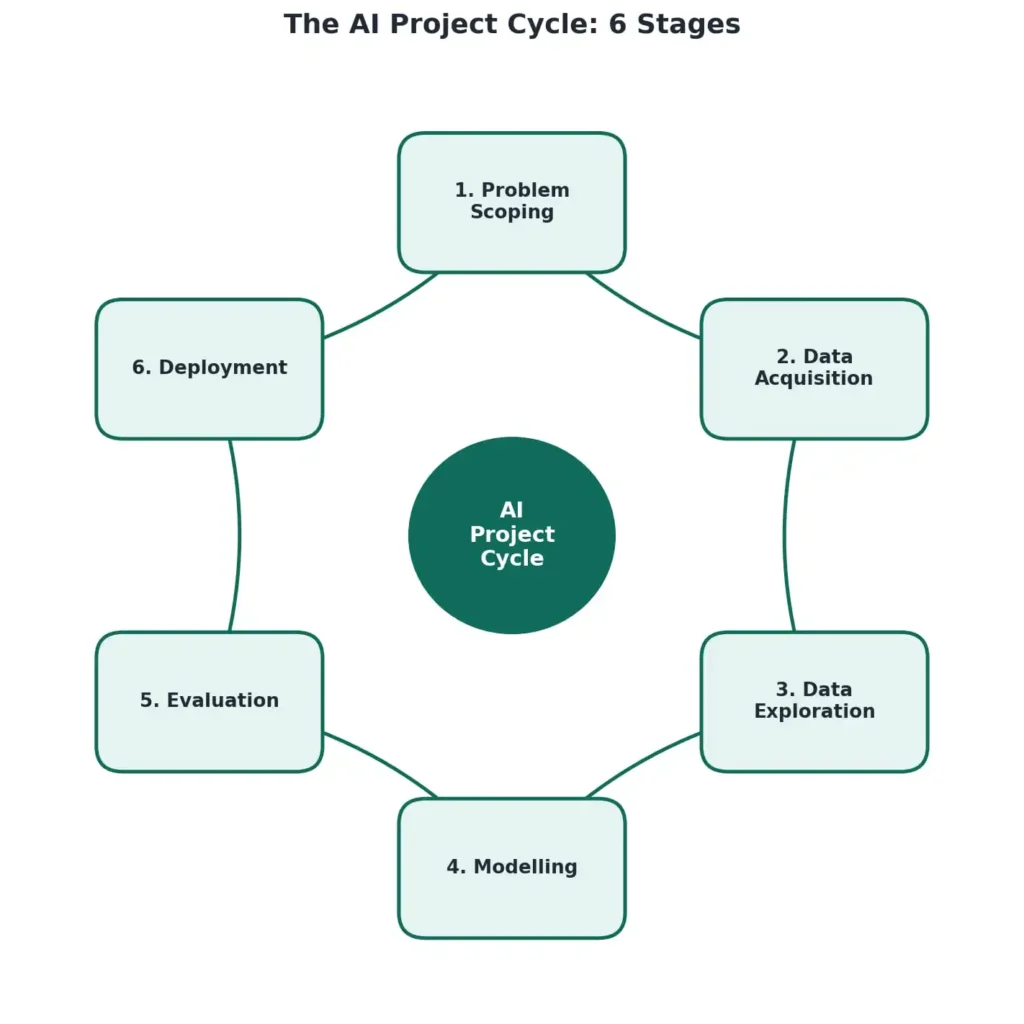
| Stage | One-Line Meaning |
|---|---|
| 1. Problem Scoping | Understand the problem clearly. Use the 4Ws Canvas (Who, What, Where, Why). |
| 2. Data Acquisition | Collect correct and reliable data. |
| 3. Data Exploration | Study the data using graphs to find patterns. |
| 4. Modelling | Build the AI model that learns from data. |
| 5. Evaluation | Test the model with new data to check how well it works. |
| 6. Deployment | Give the finished model to real users. |
Want the details? Problem scoping, the 4Ws Canvas, rule-based and learning-based models, and the confusion matrix are all explained in Class 9 Unit 1.
The Project Cycle Is Used in Every AI Domain
In Class 10, the project cycle is not used for just one kind of project. You will use it again and again in three domains. A “domain” is an area of AI.
| Domain | What It Works With | Examples | Class 10 Unit |
|---|---|---|---|
| Statistical Data | Numbers, tables, and facts | Predicting house prices, weather forecast, penguin species prediction | Unit 4 |
| Computer Vision | Images and videos | Face unlock, spotting coral bleaching in photos | Unit 5 |
| Natural Language Processing (NLP) | Human language, text, and speech | Chatbots, translation, sentiment analysis | Unit 6 |
Note: In Class 9, the first domain was called “Data”. In Class 10, it is called “Statistical Data”. The idea is the same.
Example: Take the problem of “spotting spam messages”. Problem scoping asks who gets spam and why it matters. Data acquisition collects thousands of messages. Modelling builds a model that reads text, so this is an NLP project. Evaluation checks how many spam messages the model catches. Deployment puts the model inside a phone’s messaging app.
Ethical Frameworks for AI (New Topic)
What Is an Ethical Framework?
You already know that ethics means the rules of right and wrong. An ethical framework is a set of steps or guidelines that helps us make good decisions. It makes sure our choices do not cause unintended harm.
Think of it as a map. When we face a hard moral question, the framework shows us how to think about it in an organised way.
Why Do We Need Ethical Frameworks for AI?
- AI makes decisions that affect real people. A wrong decision can hurt someone.
- We can prevent harm early. If we use a framework while building AI, we can avoid bad outcomes even before they happen.
- It gives a clear way to handle hard questions. Without a framework, everyone may decide in a different way.
Why Do People Disagree About Ethics?
Different people can reach different answers to the same ethical question. This happens because many things quietly shape our thinking, such as our culture, our religion, how much value we give to human life, and how much value we give to non-human life like animals and nature. Ethical frameworks help us look at a problem with a clear and shared method, so that these differences do not confuse us.
Types of Ethical Frameworks
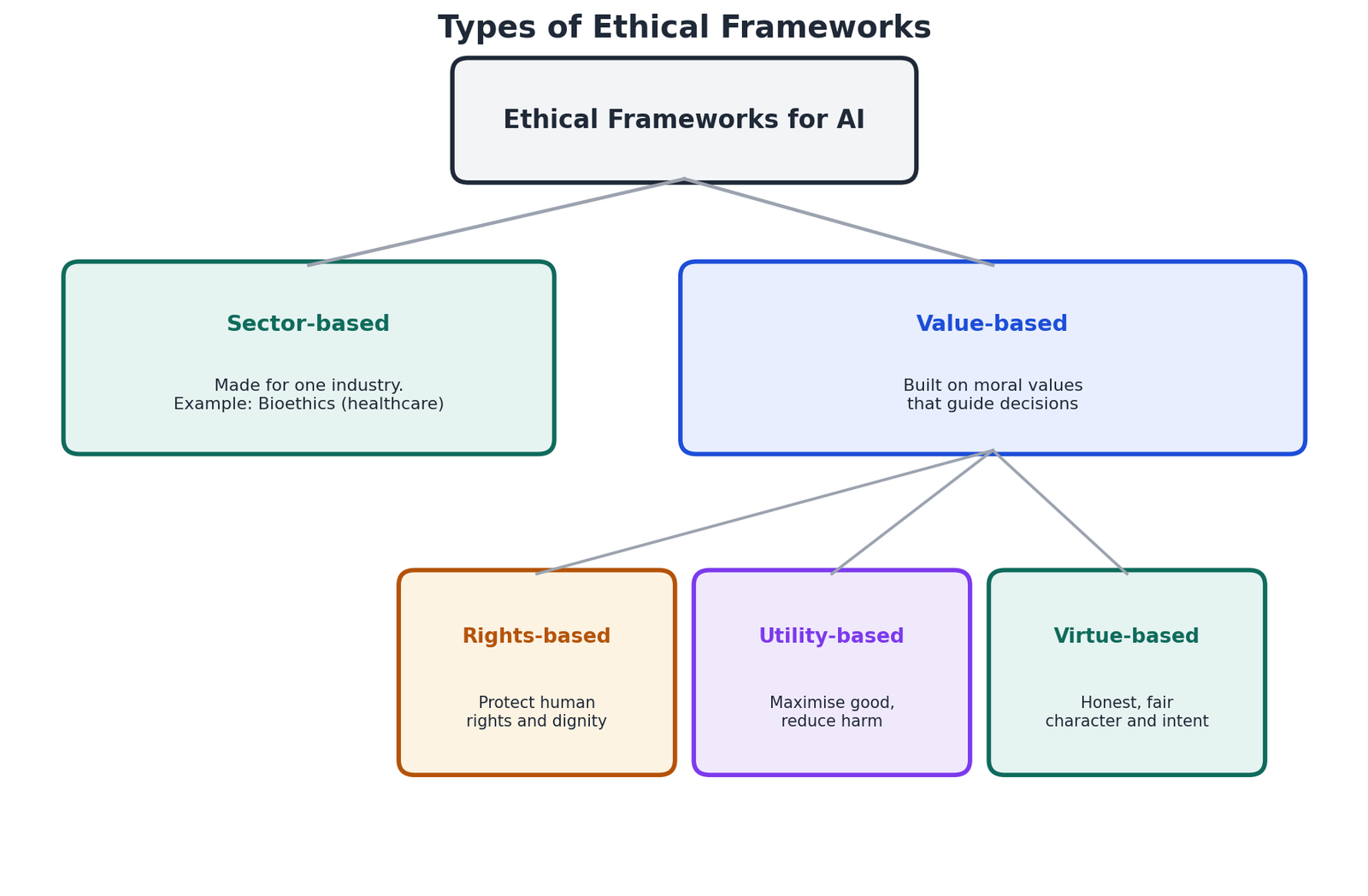
Ethical frameworks for AI are grouped into two main types. They are Sector-based frameworks and Value-based frameworks.
1. Sector-Based Frameworks
These frameworks are made for one particular industry or sector. They deal with the ethical problems that are special to that sector.
The best example is Bioethics. It is used in healthcare. It deals with issues like patient privacy, data security, and the fair use of AI in medical decisions.
Sector-based frameworks can also be made for other areas:
- Finance (banking and loans)
- Education
- Transportation (like self-driving cars)
- Agriculture
- Governance
- Law enforcement
2. Value-Based Frameworks
These frameworks are built on core values and moral ideas, such as honesty, fairness, and responsibility. They are not limited to one industry. They can be used anywhere. There are three kinds.
a) Rights-Based Framework
This framework puts human rights and dignity first. It makes sure AI does not violate anyone’s rights or treat a group unfairly.
Example: A face-recognition system should not be used to watch people without their permission, because it breaks their right to privacy.
b) Utility-Based Framework
This framework aims to create the greatest good for the greatest number of people. It weighs the benefits of an action against the harm it may cause. If the benefit is bigger, the action is considered good.
Example: An AI system that predicts floods may send warnings to many people. A few warnings may be false alarms, but it saves many lives. The overall benefit is large.
c) Virtue-Based Framework
This framework looks at the character and intentions of the people involved. It asks: are the developers, users, and regulators honest, fair, and responsible?
Example: A company that builds an AI tool should be honest about what the tool can and cannot do, even if hiding the weakness would earn more money.
| Framework | Main Question | Focus |
|---|---|---|
| Rights-based | Are people’s rights protected? | Human rights and dignity |
| Utility-based | Does this give the most good and the least harm? | Overall benefit |
| Virtue-based | Are the people involved honest and responsible? | Character and intention |
Sector-Based vs Value-Based Frameworks
| Sector-Based | Value-Based |
|---|---|
| Made for a specific industry. | Based on general moral values. |
| Deals with problems special to that sector. | Can be used in any sector. |
| Example: Bioethics in healthcare. | Examples: Rights-based, Utility-based, Virtue-based. |
Bioethics
Bioethics is an ethical framework used in healthcare and life sciences. It deals with ethical questions about health, medicine, and biology. It makes sure that AI used in healthcare follows high ethical standards.
Bioethics is a sector-based framework. Remember this, because it is often asked in exams.
The Four Principles of Bioethics
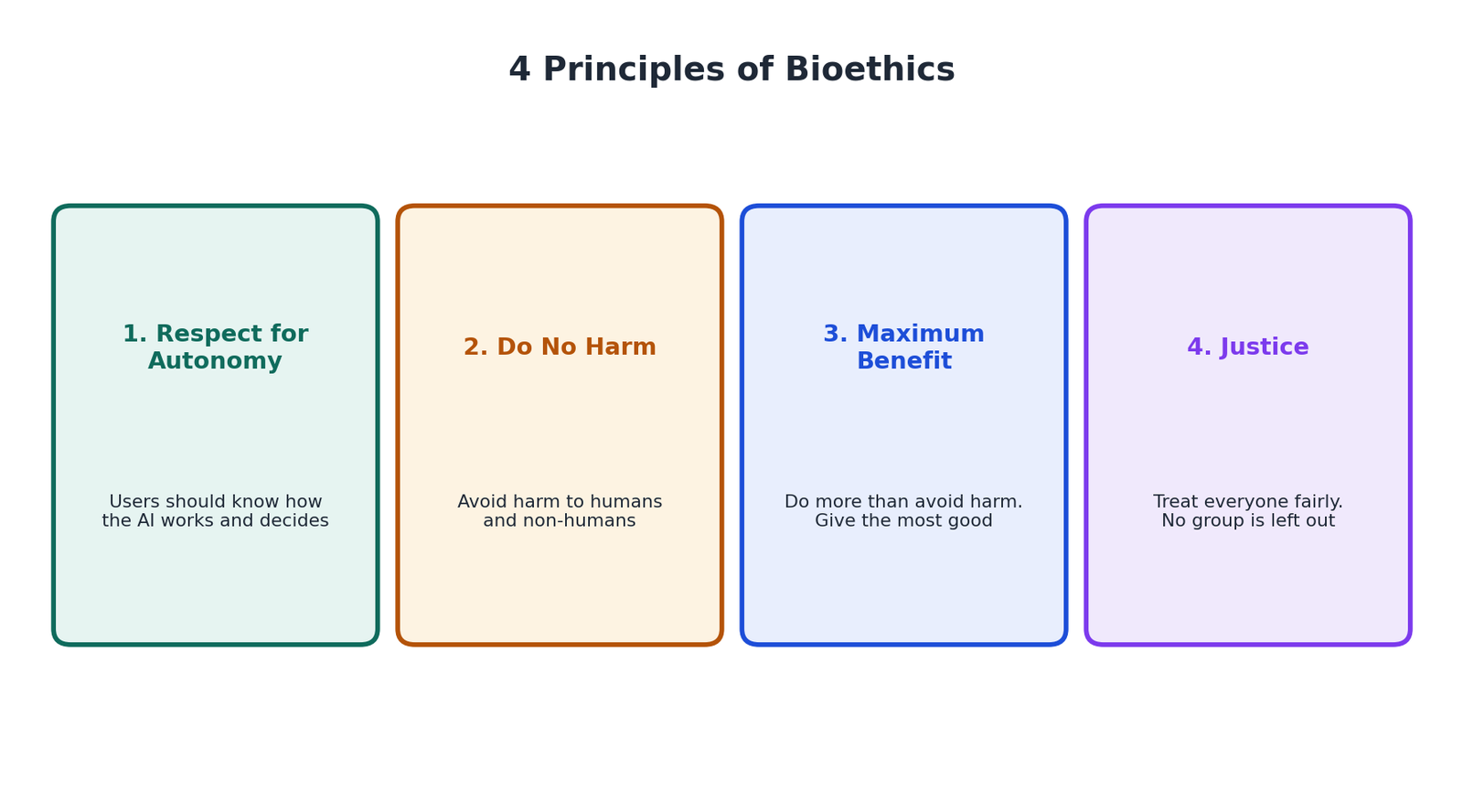
- Respect for Autonomy: People should be fully aware of how decisions are made. For example, users of an AI tool should know how it works and what it does with their data. They should have the freedom to choose.
- Do No Harm (Non-maleficence): Harm to anyone, human or non-human, must be avoided as far as possible.
- Ensure Maximum Benefit: It is not enough to avoid harm. Our actions should also try to give the most possible benefit to people.
- Give Justice: Everyone should be treated fairly. Benefits and risks should be shared in a fair way, and no group should be left out. AI should be trained on data that represents all groups.
Case Study: AI That Predicts Disease Risk
This is an example case to help you practise. Use it to understand how the principles work.
A hospital builds an AI model. It reads patient records and predicts who may get a serious disease. Let us check the model against the four principles.
| Principle | Question to Ask | What Should Be Done |
|---|---|---|
| Respect for Autonomy | Do patients know their data is used? Can they say no? | Take clear permission. Explain in simple words how the model works. |
| Do No Harm | Can a wrong prediction hurt a patient? | Test the model well. Always let a doctor check the final decision. |
| Maximum Benefit | Is the model helping as many patients as possible? | Use the predictions to give early treatment and save lives. |
| Justice | Does the model work well for all age groups, genders, and communities? | Train it on data from all groups. Check for bias. |
Activity: My Goodness
The syllabus suggests an activity called My Goodness. You can try it here: My Goodness. While you try it, think about why you make each choice. Then try to name the ethical framework your choice follows: rights-based, utility-based, or virtue-based.
Ethics in Every Stage of the AI Project Cycle
Ethics is not only about the last step. It should be part of the whole project cycle. Here is a simple way to think about it.
| Stage | Ethical Question to Ask |
|---|---|
| Problem Scoping | Who may be affected, good or bad? Are we solving a problem that really helps people? |
| Data Acquisition | Do we have permission? Does the data include all groups fairly? (Justice) |
| Data Exploration | Are some groups missing or under-represented in the data? |
| Modelling | Could the model cause harm? Does it give the most benefit? (Do no harm, Utility) |
| Evaluation | Is the model fair and accurate for everyone, not only for most people? |
| Deployment | Do users know how it works? Are their rights protected? (Autonomy, Rights) |
Ethical concerns around evaluating models are covered again in Unit 3 of Class 10.
Quick Revision Points
- The AI Project Cycle has 6 stages: Problem Scoping, Data Acquisition, Data Exploration, Modelling, Evaluation, Deployment.
- The three domains in Class 10 are Statistical Data, Computer Vision, and NLP.
- An ethical framework is a set of guidelines that helps us avoid unintended harm.
- Two types of frameworks: Sector-based and Value-based.
- Value-based frameworks are of 3 kinds: Rights-based, Utility-based, Virtue-based.
- Bioethics is a sector-based framework used in healthcare.
- The 4 principles of bioethics: Respect for Autonomy, Do No Harm, Maximum Benefit, Justice.
Multiple Choice Questions
Q1. How many stages are there in the AI Project Cycle?
a) 4 b) 5 c) 6 d) 7
Answer: c) 6
Q2. Which is the last stage of the AI Project Cycle?
a) Evaluation b) Modelling c) Data Exploration d) Deployment
Answer: d) Deployment
Q3. Which of these is a domain of AI studied in Class 10?
a) Robotics b) Computer Vision c) Gaming d) Networking
Answer: b) Computer Vision
Q4. A chatbot that understands human language belongs to which domain?
a) Computer Vision b) Statistical Data c) NLP d) None of these
Answer: c) NLP
Q5. Spotting damaged coral in photos belongs to which domain?
a) NLP b) Computer Vision c) Statistical Data d) Python
Answer: b) Computer Vision
Q6. An ethical framework is:
a) A type of AI model b) A set of guidelines to avoid unintended harm c) A kind of data d) A programming language
Answer: b) A set of guidelines to avoid unintended harm
Q7. Ethical frameworks for AI are mainly of how many types?
a) 1 b) 2 c) 3 d) 4
Answer: b) 2
Q8. Which of these is a sector-based framework?
a) Rights-based b) Utility-based c) Virtue-based d) Bioethics
Answer: d) Bioethics
Q9. Which of these is NOT a value-based framework?
a) Rights-based b) Utility-based c) Sector-based d) Virtue-based
Answer: c) Sector-based
Q10. Bioethics is mainly used in:
a) Banking b) Healthcare c) Education d) Transport
Answer: b) Healthcare
Q11. Which framework puts human rights and dignity first?
a) Rights-based b) Utility-based c) Virtue-based d) Sector-based
Answer: a) Rights-based
Q12. Which framework tries to create the greatest good for the greatest number?
a) Rights-based b) Utility-based c) Virtue-based d) Bioethics
Answer: b) Utility-based
Q13. Which framework focuses on the character and intentions of people?
a) Rights-based b) Utility-based c) Virtue-based d) Sector-based
Answer: c) Virtue-based
Q14. How many principles does bioethics have?
a) 2 b) 3 c) 4 d) 5
Answer: c) 4
Q15. “Users should know how an AI algorithm works” relates to which principle?
a) Justice b) Respect for Autonomy c) Do No Harm d) Maximum Benefit
Answer: b) Respect for Autonomy
Q16. Training AI on data that represents all groups fairly relates to which principle?
a) Justice b) Autonomy c) Maximum Benefit d) Virtue
Answer: a) Justice
Q17. Which principle says that harm to humans and non-humans must be avoided?
a) Justice b) Respect for Autonomy c) Do No Harm d) Maximum Benefit
Answer: c) Do No Harm
Q18. Why do we use ethical frameworks while building AI?
a) To make the AI slower b) To avoid unintended harm before it happens c) To avoid collecting data d) To remove testing
Answer: b) To avoid unintended harm before it happens
Q19. In Class 10, the first AI domain (called “Data” in Class 9) is named:
a) Big Data b) Statistical Data c) Raw Data d) Open Data
Answer: b) Statistical Data
Q20. The AI Project Cycle is called a “cycle” because:
a) It has a circular shape b) We may go back to earlier stages to improve the model c) It has only one stage d) It never ends
Answer: b) We may go back to earlier stages to improve the model
Assertion and Reason Questions
Choices: (a) Both A and R are true and R explains A. (b) Both A and R are true but R does not explain A. (c) A is true but R is false. (d) A is false but R is true.
Q21. Assertion (A): Bioethics is a sector-based framework.
Reason (R): It is made for the healthcare and life sciences sector.
Answer: (a) Both are true, and R explains A.
Q22. Assertion (A): Rights-based and Utility-based are sector-based frameworks.
Reason (R): They are made for one particular industry.
Answer: (d) A is false. They are value-based frameworks. R is true only for sector-based frameworks.
Case-Based Question
A bank builds an AI model to approve loans. After some time, it finds that the model rejects most loan requests from one particular community, even when the applicants are well qualified.
- Which principle of bioethics-style thinking (fairness) is missing? Answer: Justice.
- What is the likely reason for this problem? Answer: The training data was biased or did not represent all communities fairly.
- Which value-based framework would the bank break if it keeps using this model? Answer: Rights-based, because it treats a group unfairly.
- Suggest one fix. Answer: Collect balanced data from all communities, retrain the model, and test it for fairness before use.
Short Answer Questions for Revisiting AI Project Cycle class 10 notes
- Name the six stages of the AI Project Cycle.
- Why is the AI Project Cycle called a cycle?
- Name the three domains of AI studied in Class 10.
- What is an ethical framework?
- Why do we need ethical frameworks for AI?
- Name the two types of ethical frameworks.
- What is a sector-based framework? Give one example.
- What is a value-based framework? Name its three kinds.
- What is bioethics? In which sector is it used?
- Write the four principles of bioethics.
- Differentiate between sector-based and value-based frameworks.
- Explain the rights-based framework with an example.
Long Answer Questions
- Explain the six stages of the AI Project Cycle in brief. How is it used in the three domains of AI?
- What are ethical frameworks? Explain the two main types of ethical frameworks, with examples.
- Explain the three value-based frameworks: rights-based, utility-based, and virtue-based, with one example each.
- What is bioethics? Explain its four principles with the help of an AI example from healthcare.
- Explain how ethical questions can be asked at every stage of the AI Project Cycle.
Continue Your Class 10 AI Preparation
You have finished Unit 1 Revisiting AI Project Cycle class 10 notes. Next, go to the Class 10 AI notes home page for all units: Class 10 AI Notes. If you want to revise Class 9 basics, visit Class 9 AI Notes.