Introduction to Generative AI Class 9 Notes
These are simple and detailed notes for Introduction to Generative AI Class 9 notes. In this unit, we learn what Generative AI is, how it works, its types, examples, tools, benefits, limitations, and the ethical concerns around it. Let us go through every topic step by step, in easy words.
What is Generative AI?
Generative AI is a type of Artificial Intelligence that can create brand new content on its own, such as text, images, music, audio, or even video. It does not just study or sort existing data, it actually produces something new that did not exist before.
For example, if you type “write a short poem about the monsoon” into a Generative AI tool, it will instantly write an original poem for you, one that has never been written before.
Fun Activity: Guess the Real Image vs the AI-Generated Image
A fun way to understand Generative AI is to play a simple game. Look at a set of images, some real photographs and some created by AI, and try to guess which is which. This activity shows just how realistic and convincing Generative AI content has become, and also why it is so important to stay alert about what we see online.
Generative AI vs Conventional AI
Conventional AI, which we studied earlier in this subject, mostly studies, sorts, and analyses existing data. Generative AI works differently, it uses what it has learned to create something completely new. The table below shows the key differences.
| Conventional AI | Generative AI |
|---|---|
| Analyses, sorts, and classifies existing data. | Creates brand new content. |
| Output is usually a label, a score, or a prediction. | Output is new text, images, audio, or video. |
| Mostly works with fixed rules or simple labelled data. | Learns deep patterns from very large datasets. |
| Takes structured input, like a form or a set of numbers. | Often takes a simple instruction in plain language, called a prompt. |
In simple words, Conventional AI mainly tries to understand the world, while Generative AI tries to create within it.
How Does Generative AI Work?
Generative AI models are trained on a huge amount of existing data, such as millions of images, pieces of text, or songs. During training, the model studies this data very closely and learns the hidden patterns, styles, and structures inside it. Once trained, the model can use what it has learned to generate new content that follows similar patterns, but is not an exact copy of anything it has seen before.
Types of Generative AI
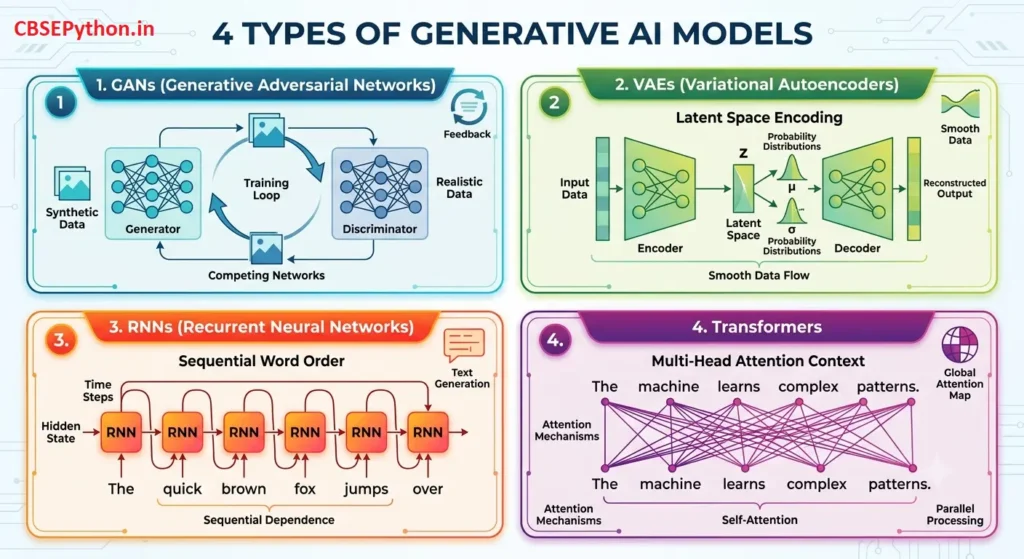
There are different kinds of Generative AI models, and each one works in its own special way. Here are four common types studied in this unit.
1. GANs (Generative Adversarial Networks)
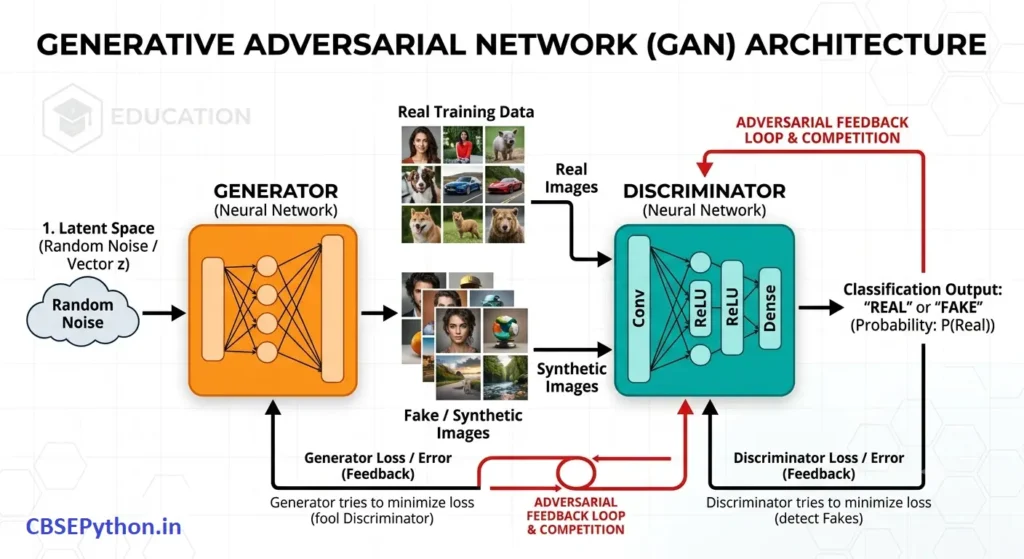
A GAN is made up of two neural networks that work against each other, almost like a game. One network, called the Generator, tries to create new, realistic-looking data. The other network, called the Discriminator, tries to tell apart real data from the fake data made by the Generator. The two networks keep competing, and over time, the Generator becomes very good at creating data that looks real.
2. VAEs (Variational Autoencoders)
A VAE is another type of model that learns the important patterns and features hidden inside a dataset. Once it understands these patterns, it can generate brand new examples that are similar to the original data, but not exact copies of it.
3. RNNs (Recurrent Neural Networks)
RNNs are good at working with data that comes in a sequence, meaning the order of the information matters. This makes RNNs useful for generating things like text or music, where each new word or note depends on what came just before it.
4. Transformers
Transformers are a newer and more powerful type of model that can understand context across long pieces of text, not just the last few words. Transformers are the technology behind popular tools like GPT models, which is why they are so good at writing natural, human-like text.
Examples of Generative AI
Generative AI is now used to create many different kinds of content.
- Text generation: Writing essays, stories, code, or holding a natural conversation. Example: ChatGPT.
- Image generation: Creating realistic photos, illustrations, or artwork from a simple text description. Example: DALL-E, Midjourney.
- Music generation: Composing original melodies, beats, or full music tracks. Example: MusicGAN.
- Video generation: Creating short video clips from text instructions. Example: OpenAI Sora.
Popular Generative AI Tools
- ChatGPT: A text-based tool used for writing, answering questions, and holding conversations.
- DALL-E: An image-generation tool that creates pictures from text descriptions.
- Artbreeder: A web-based tool that lets users blend and modify images using generative models.
- DeepArt: A tool that turns ordinary photos into artwork by applying different artistic styles.
- Runway ML: A platform for building and using different kinds of generative models, including GANs and VAEs.
- MusicGAN: A tool that generates original music based on patterns learned from existing songs.
Benefits of Using Generative AI
- Saves time: Can create drafts, designs, or ideas in seconds, which would otherwise take much longer by hand.
- Boosts creativity: Helps artists, writers, and designers get new ideas and explore new styles.
- Personalisation: Can create content tailored to a person’s own needs, taste, or request.
- Useful across industries: Helps in education, healthcare, entertainment, marketing, and business, by generating study material, designs, or even product ideas.
- Supports innovation: Helps create entirely new products, services, and business ideas that did not exist before.
Limitations of Using Generative AI
- Data bias: If the model is trained on biased or incomplete data, its output can also turn out biased or incorrect.
- Uncertainty: Generative AI can sometimes give unexpected or inconsistent results, which can be both interesting and risky.
- High computing cost: Training these models needs powerful computers and a lot of time, which can be expensive.
- Risk of fake content: Can be misused to create convincing fake images, videos, or text, known as deepfakes.
- Over-dependence: Relying too much on AI-generated content can reduce original human thinking and creativity over time.
Ethical Considerations of Using Generative AI
Since Generative AI is so powerful, it must be used responsibly. Several important ethical points need to be kept in mind.
- Misinformation: Generative AI can create very convincing fake content, such as deepfakes, which can spread false information and mislead people.
- Disclosure of sensitive information: Generative AI tools do not always know which information is safe to share, so they may accidentally reveal sensitive or private details.
- Copyright and ownership: Since Generative AI learns from existing human-made work, questions often arise about who actually owns the new content it creates.
- Impact on jobs: As Generative AI becomes better at writing, designing, and creating, it may affect certain creative and content-related jobs.
- Need for open discussion: Since Generative AI affects society in many ways, open conversations about its responsible use are very important.
Negative Impact of Generative AI on Society
Along with its many benefits, Generative AI can also cause harm if used carelessly. It can spread misinformation through deepfakes, reduce trust in real photos and videos, and be used to copy someone’s work or voice without their permission. This is why learning about AI Ethics, which we studied in Unit 1, becomes even more important when we talk about Generative AI.
Multiple Choice Questions
Q1. Generative AI is mainly used to:
a) Sort existing data
b) Create new content
c) Delete old files
d) Store data safely
Answer: b) Create new content
Q2. Which of these is an example of a Generative AI tool?
a) A calculator
b) ChatGPT
c) A spreadsheet
d) A file manager
Answer: b) ChatGPT
Q3. Conventional AI mainly focuses on:
a) Creating new content
b) Analysing and classifying existing data
c) Writing poems
d) Composing music
Answer: b) Analysing and classifying existing data
Q4. In a GAN, the network that creates new data is called the:
a) Discriminator
b) Generator
c) Classifier
d) Evaluator
Answer: b) Generator
Q5. In a GAN, the network that tries to catch fake data is called the:
a) Generator
b) Discriminator
c) Transformer
d) Encoder
Answer: b) Discriminator
Q6. GAN stands for:
a) General Artificial Network
b) Generative Adversarial Network
c) Generated Automated Node
d) Global AI Network
Answer: b) Generative Adversarial Network
Q7. Which type of Generative AI model is best suited for sequential data, like text or music?
a) GANs
b) VAEs
c) RNNs
d) None of these
Answer: c) RNNs
Q8. Which type of model is the technology behind GPT, and is good at understanding long context?
a) GANs
b) VAEs
c) RNNs
d) Transformers
Answer: d) Transformers
Q9. DALL-E is mainly used for generating:
a) Music
b) Images
c) Code
d) Spreadsheets
Answer: b) Images
Q10. A realistic fake video or image created using Generative AI is called a:
a) Screenshot
b) Deepfake
c) Template
d) Snapshot
Answer: b) Deepfake
Q11. If a Generative AI model is trained on unfair or incomplete data, its output can show:
a) Better accuracy
b) Bias
c) Faster speed
d) Lower cost
Answer: b) Bias
Q12. Which of these is a benefit of using Generative AI?
a) It always needs no electricity
b) It saves time by creating drafts and ideas quickly
c) It never makes mistakes
d) It replaces the need for all human creativity
Answer: b) It saves time by creating drafts and ideas quickly
Q13. Which of these is a limitation of Generative AI?
a) It is always completely accurate
b) It needs a lot of computing power to train
c) It never needs any data
d) It cannot be misused
Answer: b) It needs a lot of computing power to train
Q14. Which tool is mainly used to turn photos into artwork using different artistic styles?
a) ChatGPT
b) DeepArt
c) MusicGAN
d) Runway ML
Answer: b) DeepArt
Q15. Spreading false information using realistic AI-generated content is an example of:
a) A benefit of Generative AI
b) An ethical concern of Generative AI
c) A type of Generative AI
d) A Generative AI tool
Answer: b) An ethical concern of Generative AI
Q16. OpenAI Sora is mainly used for generating:
a) Text
b) Images
c) Video
d) Spreadsheets
Answer: c) Video
Q17. Learning hidden patterns in data and generating new, similar examples is mainly done by:
a) GANs
b) VAEs
c) RNNs
d) None of these
Answer: b) VAEs
Q18. The short input instruction given to a Generative AI tool, usually in plain language, is called a:
a) Label
b) Prompt
c) Dataset
d) Feature
Answer: b) Prompt
Q19. A key difference between Conventional AI and Generative AI is that Generative AI:
a) Only works with numbers
b) Creates new content instead of just analysing data
c) Cannot be trained on data
d) Does not use neural networks
Answer: b) Creates new content instead of just analysing data
Q20. Why is it important to discuss the ethics of Generative AI openly?
a) Because it has no real impact on society
b) Because it is only used by scientists
c) Because it can affect many people and needs responsible use
d) Because it is not connected to AI Ethics
Answer: c) Because it can affect many people and needs responsible use
Short Answer Questions
- What is Generative AI? Give one example.
- What is the main difference between Generative AI and Conventional AI?
- Explain how a GAN works, using the terms Generator and Discriminator.
- What are VAEs? How are they different from GANs?
- Why are RNNs useful for generating text or music?
- What are Transformers? Name one popular tool based on them.
- Name any three examples of Generative AI, with one tool for each.
- Give any three benefits of using Generative AI.
- Give any three limitations of using Generative AI.
- What is a deepfake? Why is it considered risky?
Long Answer Questions
- What is Generative AI? Explain how it is different from Conventional AI, with a comparison table.
- Explain the four types of Generative AI models: GANs, VAEs, RNNs, and Transformers, with their key features.
- Explain the benefits and limitations of using Generative AI, with suitable examples.
- What are the main ethical considerations around Generative AI? Explain with examples, including the negative impact it can have on society.