Class 10 AI Notes 2026-27: CBSE Artificial Intelligence (Code 417)
Looking for simple and complete Class 10 AI notes? You are in the right place. This page covers the full CBSE Artificial Intelligence syllabus for the 2026-27 session. Every unit has its own detailed notes, with MCQs, short questions, and long questions. The practical units also have tested programs and step-by-step project guides.
All notes are written in easy to understand language. Topics you already studied in Class 9 are linked back to the Class 9 notes. So you only spend your time on what is new.
What you will find on this page: syllabus overview, marks distribution, unit-wise notes links, a Class 9 to Class 10 connection map, formulas cheat sheet, key terms, study plan, practical and project guide, and FAQs.
Artificial Intelligence Class 10 Notes
Quick Links
- About CBSE Class 10 AI (Code 417)
- Class 10 AI Syllabus 2026-27 at a Glance
- Marks Distribution and Exam Pattern
- Unit-Wise Class 10 AI Notes
- How Class 9 and Class 10 Connect
- Which Units Are Most Important?
- Formulas Cheat Sheet
- Quick Revision: Key Terms
- How to Study Class 10 AI
- Practical Work and Project Ideas
- Frequently Asked Questions
About CBSE Class 10 AI (Code 417)
Artificial Intelligence is a skill subject in CBSE Class 10. Its subject code is 417. Students take it along with their other subjects.
The Class 10 course builds on Class 9. It revisits the AI Project Cycle and ethics. Then it goes deeper into how AI models learn, how they are tested, and how AI works with numbers, images, and language. It ends with Python programming for AI.
The course is hands-on. You will use free tools like Orange Data Mining, Teachable Machine, and Jupyter Notebook to build real AI projects.
Class 10 AI Syllabus 2026-27 at a Glance
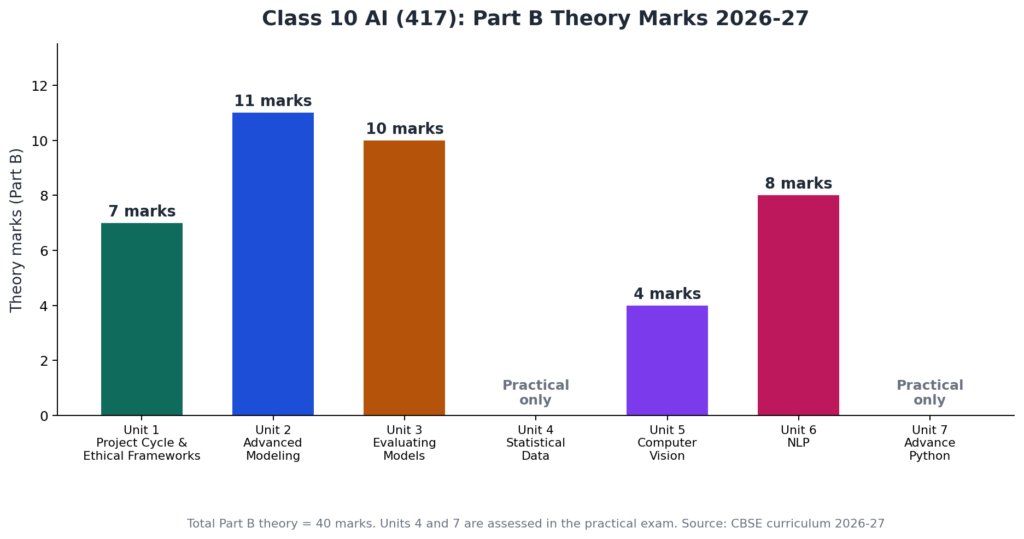
The subject specific part (Part B) has seven units. The table below shows the hours and marks for each unit, as given in the CBSE curriculum for 2026-27.
| Unit | Unit Name | Theory Hours | Practical Hours | Marks |
|---|---|---|---|---|
| 1 | Revisiting AI Project Cycle & Ethical Frameworks for AI | 11 | 4 | 7 |
| 2 | Advanced Concepts of Modeling in AI | 18 | 7 | 11 |
| 3 | Evaluating Models | 21 | 4 | 10 |
| 4 | Statistical Data | – | 28 | – |
| 5 | Computer Vision | 10 | 20 | 4 |
| 6 | Natural Language Processing | 20 | 7 | 8 |
| 7 | Advance Python | 10 | – | – |
| Total | 160 hours | 40 | ||
Units 4 and 7 have no theory marks. They are assessed through the practical exam. Units 5 and 6 have a theory part (which carries the marks shown) and a practical part.
Marks Distribution and Exam Pattern
Class 10 AI is worth 100 marks in total. These are split into 50 marks for theory and 50 marks for practical and project work.
| Part | What It Covers | Marks |
|---|---|---|
| Part A | Employability Skills (5 units of 2 marks each) | 10 |
| Part B | Subject Specific Skills (Units 1 to 7) | 40 |
| Part C | Practical file (minimum 15 programs) | 15 |
| Practical examination (Units 4, 5, 6 and 7) | 15 | |
| Viva voce | 5 | |
| Project work / Field visit / Student portfolio (any one) | 10 | |
| Viva voce (on project work) | 5 | |
| Total | 100 |
Note: Always check the latest circular and sample paper from CBSE and your school. The pattern can be updated.
Unit-Wise Class 10 AI Notes
Click on any unit below to read its full notes. Each page has detailed explanations, diagrams, MCQs, assertion-reason questions, a case-based question, short answer questions, and long answer questions.
Unit 1: Revisiting AI Project Cycle and Ethical Frameworks for AI (7 Marks)
A short revision of the AI Project Cycle, followed by new content on ethical frameworks. You learn sector-based and value-based frameworks, and the four principles of bioethics.
- AI Project Cycle recap and the three domains: Statistical Data, Computer Vision, NLP
- Sector-based vs value-based ethical frameworks
- Rights-based, utility-based, and virtue-based frameworks
- Bioethics and its four principles
Read Unit 1 Notes: Project Cycle and Ethical Frameworks »
Unit 2: Advanced Concepts of Modeling in AI (11 Marks)
The highest-scoring unit. You learn how AI models really learn, from AI vs ML vs DL to neural networks.
- AI, ML, and DL, and common data terms
- Supervised, unsupervised, and reinforcement learning
- Classification, regression, clustering, and association
- Neural networks, ANN, CNN, and how AI makes a decision
Read Unit 2 Notes: Advanced Modeling in AI »
Unit 3: Evaluating Models (10 Marks)
Learn how to test a model and judge how good it is. This unit has many calculation questions, so practise it well.
- Train-test split
- Accuracy and error
- Confusion matrix, precision, recall, and F1 score, with solved examples
- Choosing the right metric, and ethical concerns in evaluation
Read Unit 3 Notes: Evaluating Models »
Unit 4: Statistical Data (Practical Unit)
Build a full AI project without writing code. You learn no-code AI and the Orange Data Mining tool, and you work through the Palmer Penguins case study.
- Data science and its applications
- Range, variance, and standard deviation
- Code, low-code, and no-code AI
- Orange Data Mining, the penguin species project, and MS Excel statistics
Read Unit 4 Notes: Statistical Data »
Unit 5: Computer Vision (4 Marks + Practical)
Learn how a computer sees images. You study pixels, convolution, and CNN layers, and build a model with Teachable Machine.
- Four tasks of Computer Vision
- Pixels, grayscale, and RGB images
- Kernel, convolution, and CNN layers (convolution, ReLU, pooling, fully connected)
- Teachable Machine, Lobe, and the Coral Bleaching case study
Read Unit 5 Notes: Computer Vision »
Unit 6: Natural Language Processing (8 Marks + Practical)
Learn how computers understand human language, from the five stages of NLP to turning text into numbers.
- Features of natural languages and the five stages of NLP
- Script bots and smart bots
- Text normalisation, Bag of Words, and TFIDF with solved examples
- Sentiment analysis with Orange
Read Unit 6 Notes: Natural Language Processing »
Unit 7: Advance Python (Practical Unit)
Write real Python programs for your practical file. All 15 programs are tested, with outputs.
- Jupyter Notebook, virtual environments, and installing packages
- NumPy, Pandas, Matplotlib, and OpenCV
- Mean, median, mode, line chart, scatter chart
- Reading CSV files and images
Read Unit 7 Notes: Advance Python »
How Class 9 and Class 10 Connect
Many Class 10 topics build on Class 9. If a Class 10 idea feels hard, go back to the Class 9 topic first. This table shows where each idea starts and where it grows.
| Topic | Learn It First (Class 9) | Goes Deeper (Class 10) |
|---|---|---|
| AI Project Cycle and the 4Ws Canvas | Class 9 Unit 1 | Unit 1, and used in Units 4, 5, 6 |
| Three domains of AI | Class 9 Unit 1 | Units 4 (Statistical Data), 5 (Computer Vision), 6 (NLP) |
| AI ethics, bias, and privacy | Class 9 Unit 1 | Unit 1 (frameworks) and Unit 3 |
| Rule-based and learning-based models | Class 9 Unit 1 | Unit 2 |
| Training data, testing data, confusion matrix | Class 9 Unit 1 | Unit 3 |
| Data types, features, and data interpretation | Class 9 Unit 2 | Unit 4 |
| Mean, median, mode, and charts | Class 9 Unit 3 | Unit 4 and Unit 7 (with code) |
| Generative AI and chatbots | Class 9 Unit 4 | Unit 6 |
| Python basics | Class 9 Unit 5 | Unit 7 |
Starting from the beginning? Visit the Class 9 AI Notes page.
Which Units Are Most Important?
Look at the theory marks. Unit 2 (11 marks) and Unit 3 (10 marks) together carry 21 out of 40 marks in Part B. That is more than half. Unit 3 also has many calculation questions, where careful practice earns full marks.
Unit 6 (NLP) carries 8 marks, Unit 1 carries 7 marks, and Unit 5 (Computer Vision) carries 4 marks.
Do not ignore the practical units. Units 4, 5, 6, and 7 make up the practical exam. Together with the practical file, viva, and project, practical work carries 50 marks, which is half of the subject.
A good order of study is: Unit 2, then Unit 3, then Unit 6, then Unit 1, then Unit 5. Spend the rest of your time on the practical units (4 and 7), and on the practical parts of Units 5 and 6.
Formulas Cheat Sheet
Learn these by heart. Most of the calculation questions in Class 10 AI come from this list.
| Topic | Formula | Unit |
|---|---|---|
| Accuracy | (TP + TN) ÷ (TP + TN + FP + FN) | 3 |
| Error rate | 100% − Accuracy, or Wrong predictions ÷ Total predictions | 3 |
| Precision | TP ÷ (TP + FP) | 3 |
| Recall | TP ÷ (TP + FN) | 3 |
| F1 score | 2 × Precision × Recall ÷ (Precision + Recall) | 3 |
| Range | Largest value − Smallest value | 4 |
| Variance | Average of the squared distances from the mean | 4 |
| Standard deviation | Square root of the variance | 4 |
| Number of pixels | Width × Height | 5 |
| Convolution output size (no padding) | N − K + 1, for an N × N image and a K × K kernel | 5 |
| ReLU | Negative values become 0. Positive values stay the same | 5 |
| TFIDF | TF × log(N ÷ DF) | 6 |
Quick Revision: Key Terms
Use this table for fast revision before your test.
| Term | Simple Meaning | Unit |
|---|---|---|
| Ethical framework | A set of guidelines that helps us avoid unintended harm. | 1 |
| Sector-based framework | An ethical framework made for one industry, like bioethics for healthcare. | 1 |
| Value-based framework | A framework built on moral values: rights-based, utility-based, or virtue-based. | 1 |
| Bioethics principles | Respect for autonomy, do no harm, maximum benefit, and justice. | 1 |
| Machine Learning | AI that learns patterns from data. | 2 |
| Deep Learning | Machine learning using neural networks with many layers. | 2 |
| Supervised learning | Learning from labelled data. | 2 |
| Unsupervised learning | Finding patterns in unlabelled data. | 2 |
| Reinforcement learning | Learning by reward and penalty. | 2 |
| Classification | Predicting a category. | 2 |
| Regression | Predicting a number. | 2 |
| Clustering | Grouping similar data without labels. | 2 |
| Neural network | A model with input, hidden, and output layers, inspired by the brain. | 2 |
| Train-test split | Dividing data into a training part and a testing part. | 3 |
| Confusion matrix | A table of TP, TN, FP, and FN. | 3 |
| Precision | How many “Yes” predictions were truly Yes. | 3 |
| Recall | How many real “Yes” cases were found. | 3 |
| No-code AI | Building AI projects without writing code. | 4 |
| Orange widget | A box in Orange that does one task. | 4 |
| Population and sample | The whole group, and a part chosen from it. | 4 |
| Pixel | The smallest dot of an image. | 5 |
| Kernel | A small grid of numbers that slides over an image. | 5 |
| CNN | A deep learning model made for images. | 5 |
| Pooling | A CNN layer that shrinks the feature map. | 5 |
| Lexical analysis | The first NLP stage. It breaks text into sentences and words. | 6 |
| Pragmatic analysis | The last NLP stage. It finds the real intention. | 6 |
| Corpus | The collection of all text used in an NLP project. | 6 |
| Stopwords | Common words, like “the” and “is”, that add little meaning. | 6 |
| Bag of Words | An NLP model that counts words and ignores their order. | 6 |
| TFIDF | A score for how important a word is in a document. | 6 |
| Virtual environment | A private space with its own packages for one Python project. | 7 |
| DataFrame | A table of rows and columns in Pandas. | 7 |
How to Study Class 10 AI
- Check the Class 9 base first. Use the connection table above. A quick read of the Class 9 topic makes the Class 10 topic easy.
- Read each unit once, slowly. Understand the examples before moving on.
- Practise the numericals. For Unit 3 (metrics), Unit 4 (variance), Unit 5 (convolution and pooling), and Unit 6 (TFIDF), solve the examples by hand until you can do them without notes.
- Draw the diagrams. The neural network, confusion matrix, CNN layers, and NLP stages are often asked.
- Solve the MCQs, assertion-reason, and case-based questions. Do them without looking at the answers first.
- Run the tools yourself. Use Orange, Teachable Machine, and Jupyter. The practical exam rewards hands-on practice.
- Revise with the key terms and formulas tables. Do this a day before the exam.
Practical Work and Project Ideas
Practical and project work carries 50 marks, so start early.
Practical File and Exam
You need a practical file with at least 15 programs. The practical exam covers Unit 4 (Statistical Data), Unit 5 (Computer Vision), Unit 6 (NLP), and Unit 7 (Advance Python). You will also face a viva.
The syllabus gives a suggested list of programs. It includes adding the elements of two lists, finding mean, median, and mode with NumPy, drawing a line chart and a scatter chart, reading a CSV file and showing its rows and information, and reading an image and showing its shape. All of these are explained, tested, and shown with output in Unit 7 notes, along with 7 extra programs to complete your file.
Project Work, Field Visit, or Portfolio
You must do any one of these, and it should relate to the Sustainable Development Goals.
- Project 1, Statistical Data: Predict the species of a Palmer penguin. See Unit 4.
- Project 2, Computer Vision: Early detection of coral bleaching. See Unit 5.
- Project 3, NLP: Sentiment analysis of reviews. See Unit 6.
- Field work: Take part in an AI for Youth Bootcamp, an AI fest or exhibition, or an AI training session. You can also take virtual tours of companies that use AI.
- Student portfolio: Keep a record of all your AI activities, continuing from Class 9. It should have at least 5 activities. You can also add hackathons and competitions.
Frequently Asked Questions (FAQs)
What is the subject code of AI in CBSE Class 10?
The subject code of Artificial Intelligence in CBSE Class 10 is 417.
How many units are there in Class 10 AI?
Part B has seven units: Revisiting AI Project Cycle and Ethical Frameworks for AI; Advanced Concepts of Modeling in AI; Evaluating Models; Statistical Data; Computer Vision; Natural Language Processing; and Advance Python.
What is the marks distribution of Class 10 AI?
The total is 100 marks. Theory is 50 marks (Part A employability skills 10, and Part B subject specific skills 40). Practical and project work is 50 marks.
Which unit carries the most theory marks?
Unit 2 (Advanced Concepts of Modeling in AI) carries the most, with 11 marks. Unit 3 (Evaluating Models) is next, with 10 marks.
Which units are assessed through practicals?
Unit 4 (Statistical Data) and Unit 7 (Advance Python) are assessed through practicals. Units 5 (Computer Vision) and 6 (NLP) have a theory part and a practical part.
How many programs are needed in the practical file?
The practical file needs at least 15 programs. You can find all the suggested programs, plus extras, with outputs in our Unit 7 notes.
Is Class 9 AI knowledge needed for Class 10?
Yes, it helps a lot. The AI Project Cycle, ethics, data types, statistics, and Python basics from Class 9 are used again in Class 10. Our notes link every repeated topic back to the Class 9 notes.
How can I score well in Class 10 AI?
Focus on Unit 2 and Unit 3 first. Practise the numericals and diagrams. Run the tools yourself, prepare your practical file of 15 programs early, and revise with the formulas and key terms tables before the exam.
Are these Class 10 AI notes free?
Yes. All the notes on this website are free to read.
Start Learning Now
Pick a unit and begin. If you are not sure where to start, begin with Unit 1: Revisiting AI Project Cycle and Ethical Frameworks. If you need the basics, go to the Class 9 AI Notes page. Bookmark this page, so that you can come back to all unit notes in one place.