Math for AI Class 9 Notes
These are simple and detailed notes for Class 9 AI Unit 3, Math for AI. In this unit, we learn why maths is important for AI, and we study two important areas in detail, Statistics and Probability. Let us go through every topic step by step, in easy words.
Why is Math Important for AI?
Maths is the base on which AI stands. Without maths, a computer cannot find patterns, cannot compare values, and cannot make predictions. Maths gives AI the tools it needs to study data and make smart decisions.
At its core, maths is the study of patterns. When we solve a puzzle, we are actually looking for a pattern or an order hidden inside numbers or images. AI works in a similar way. AI looks at large amounts of data and tries to find a pattern inside it, just like we do while solving a puzzle.
Number pattern example: Look at this series and find the missing number: 2, 4, 6, 8, 10, 12, __. Here the pattern is simple, each number increases by 2. AI can be trained to spot such patterns automatically, even in much bigger and more complex sets of numbers.
Picture analogy example: Sometimes patterns are not just in numbers, they can be in images too. If we are shown a set of images and asked to connect them logically, we are actually finding a visual pattern. AI uses the same idea when it learns to recognise similar objects in different photos.
Four Areas of Math Used in AI
In Class 9, we focus on four important areas of maths that are used heavily in AI.
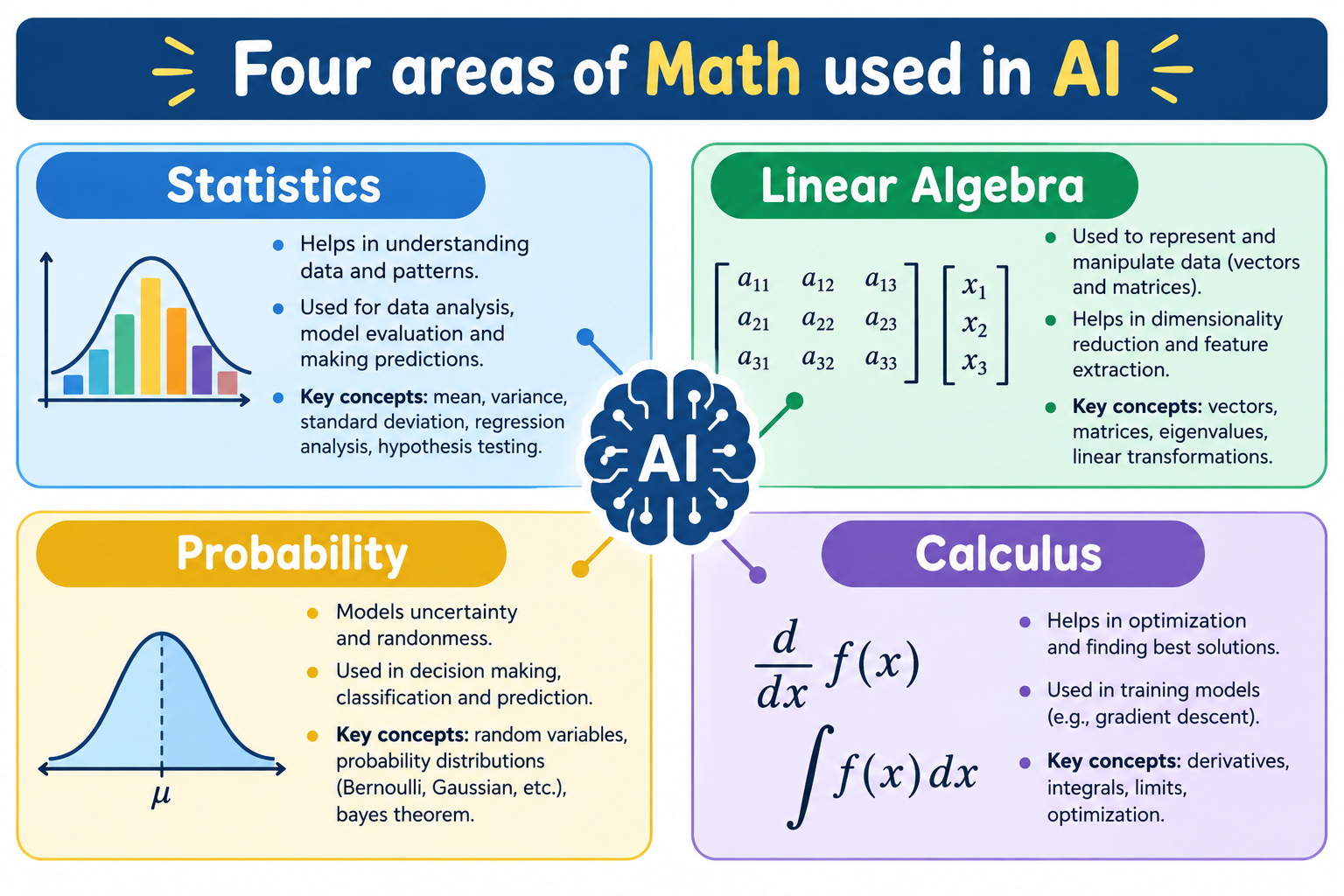
- Statistics (Exploring data): Helps us answer questions like “What is the middle value of the data?” or “Which value appears the most?”
- Linear Algebra (Finding unknown values): Helps us answer questions like “How many plants are there in total?” or “How many cars are there in a city?”
- Probability (Predicting events): Helps us answer questions like “What could happen if we toss a coin?” or “Will it rain tomorrow?”
- Calculus (Training and improving AI models): Helps us answer questions like “Which line is more slanted?” or “Which shape covers more area?”
In this unit, we will study Statistics and Probability in more detail, since these two are used the most in the AI Project Cycle.
Statistics in AI
Statistics is the branch of maths used for collecting, exploring, and studying data. It also helps us draw useful conclusions from that data. Since AI depends completely on data, statistics plays a very important role in almost every AI project.
Why Do We Need Statistics in AI?
Data usually comes from many different sources, and in a raw form, it can be messy and hard to understand. Statistics helps an AI system organise and study this data properly. Once the data is understood well, it becomes much easier for AI to make correct predictions.
Measures of Central Tendency: Mean, Median and Mode
One of the simplest and most useful tools in statistics is finding the “middle” or “typical” value in a set of data. There are three common ways to do this.
- Mean: This is the average of all the values. We add all the numbers together and divide by how many numbers there are. Example: For the numbers 10, 20, and 30, the mean is (10 + 20 + 30) ÷ 3 = 20.
- Median: This is the middle value, once all the numbers are arranged in order. Example: For the numbers 3, 5, 9, the median is 5, since it sits in the middle after arranging the numbers.
- Mode: This is the value that appears most often in the data. Example: In the set 2, 3, 3, 5, 7, the mode is 3, because it appears twice, more than any other number.
These three simple measures help AI models quickly understand what a “typical” value looks like in a large dataset.
Applications of Statistics in Real Life
- Disaster Management: Statistics helps authorities warn people living in places that may soon be affected by a natural disaster.
- Sports: Statistics is used to study player performance, match results, and even health-related events. For example, past sports events have been rescheduled based on statistical study of disease spread in the host city.
- Disease Prediction: Governments use statistics to study which diseases are affecting people the most in a certain area, which then helps them plan health programs like vaccination drives more effectively.
- Weather Forecast: By studying weather patterns from past seasons, statistics helps AI make a good guess about the weather in the coming days.
Class Activity: Car Spotting and Tabulating
This is a simple hands-on activity to understand data collection and statistics. In this activity, you stand at a safe spot and note down details about the cars passing by, such as their colour or type, for a fixed amount of time. Once you have collected this data, you arrange it neatly in a table, and then try to answer simple questions from it, such as “Which colour of car was seen the most?” This activity shows how data collection directly connects to statistics, and how it can even connect to AI Project Cycle ideas we studied earlier.
Probability in AI
Probability is a way of measuring how likely something is to happen. It tells us the chance of an event happening, using a number between 0 and 1.
The Probability Formula
Probability of an event = Number of favourable outcomes ÷ Total number of outcomes
Example: Take a fair coin. It has two possible outcomes, heads or tails. Since both outcomes are equally likely, the probability of getting heads is 1/2, and the probability of getting tails is also 1/2.
Understanding the Probability Scale
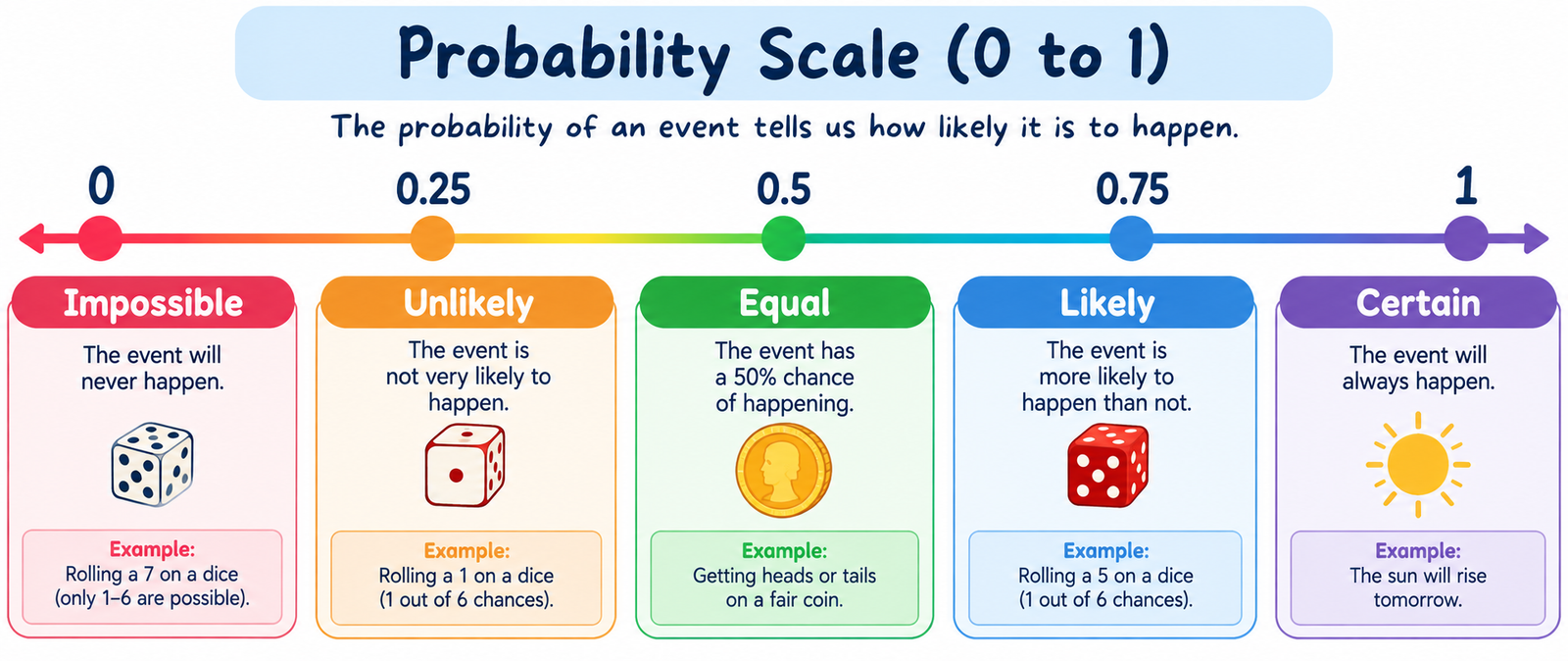
Every probability value lies between 0 and 1. A probability of 0 means the event will never happen. A probability of 1 means the event is certain to happen. Values in between tell us how likely or unlikely something is.

Types of Events in Probability
- Certain events: Events that will definitely happen. Probability is 1.
- Likely events: Events that have a higher chance of happening compared to other events.
- Unlikely events: Events that have a lower chance of happening compared to other events.
- Impossible events: Events that have no chance of happening at all. Probability is 0.
- Equal probability events: Events where every outcome has exactly the same chance of happening.
Applications of Probability in Real Life
- Sports: Probability helps analyse a player’s performance. For example, if a batsman usually scores 45 runs out of every 100 balls faced, there is a good chance he may score close to that in the next match too.
- Weather Forecast: Weather apps commonly show the “chance of rain” as a percentage. This percentage is calculated using probability, based on past weather patterns.
- Traffic Estimation: Certain areas often get heavy traffic at certain times of the day. Probability helps in estimating how likely heavy traffic is at a particular time and place.
How Statistics and Probability Work Together in AI
Statistics and probability are closely connected. Statistics helps us understand and organise the data we already have, while probability helps us make a smart guess about what might happen next, based on that data. Together, these two areas of maths give AI the power to learn from the past and make useful predictions about the future.
Multiple Choice Questions
Q1. Which branch of maths helps AI understand data patterns?
a) Calculus
b) Statistics
c) Geometry
d) Trigonometry
Answer: b) Statistics
Q2. Which area of maths helps in finding unknown or missing values, like the total number of cars in a city?
a) Probability
b) Calculus
c) Linear Algebra
d) Statistics
Answer: c) Linear Algebra
Q3. Which area of maths is mainly used for training and improving AI models?
a) Statistics
b) Calculus
c) Probability
d) Linear Algebra
Answer: b) Calculus
Q4. The average of a set of numbers is called the:
a) Median
b) Mode
c) Mean
d) Range
Answer: c) Mean
Q5. The middle value in a sorted list of numbers is called the:
a) Mean
b) Median
c) Mode
d) Total
Answer: b) Median
Q6. The value that appears most often in a dataset is called the:
a) Mean
b) Median
c) Mode
d) Average
Answer: c) Mode
Q7. What is the mean of the numbers 10, 20 and 30?
a) 10
b) 20
c) 30
d) 60
Answer: b) 20
Q8. The probability of an event that is certain to happen is:
a) 0
b) 0.5
c) 1
d) 2
Answer: c) 1
Q9. The probability of an impossible event is:
a) 0
b) 0.5
c) 1
d) It cannot be found
Answer: a) 0
Q10. When you toss a fair coin, the probability of getting heads is:
a) 0
b) 1/4
c) 1/2
d) 1
Answer: c) 1/2
Q11. An event where every outcome has the same chance of happening is called:
a) A likely event
b) An unlikely event
c) An equal probability event
d) An impossible event
Answer: c) An equal probability event
Q12. Statistics is mainly used for:
a) Drawing pictures
b) Collecting, exploring and analysing data
c) Writing computer code
d) Designing websites
Answer: b) Collecting, exploring and analysing data
Q13. Which real-life example uses statistics to warn people about upcoming natural disasters?
a) Weather forecast
b) Disaster management
c) Traffic estimation
d) Sports analysis
Answer: b) Disaster management
Q14. Predicting the chance of rain in a weather app is an example of using:
a) Calculus
b) Probability
c) Linear Algebra
d) Data Acquisition
Answer: b) Probability
Q15. The probability formula is:
a) Total outcomes ÷ Favourable outcomes
b) Favourable outcomes ÷ Total outcomes
c) Favourable outcomes × Total outcomes
d) Total outcomes − Favourable outcomes
Answer: b) Favourable outcomes ÷ Total outcomes
Q16. Maths is mainly described as the study of:
a) Colours
b) Patterns
c) Languages
d) Machines
Answer: b) Patterns
Q17. What is the mode of the numbers 2, 3, 3, 5, 7?
a) 2
b) 3
c) 5
d) 7
Answer: b) 3
Q18. An event that has a lower chance of happening compared to other events is called:
a) A certain event
b) A likely event
c) An unlikely event
d) An equal probability event
Answer: c) An unlikely event
Q19. The Car Spotting and Tabulating activity mainly helps students understand:
a) Deployment
b) Data collection and statistics
c) Data privacy
d) Calculus
Answer: b) Data collection and statistics
Q20. Studying past weather patterns to guess future weather is an example of:
a) Calculus in AI
b) Statistics helping probability-based prediction
c) Linear Algebra
d) Data privacy
Answer: b) Statistics helping probability-based prediction
Short Answer Questions
- Why is maths important for AI? Explain in simple words.
- Name the four areas of maths used in AI, with one example each.
- What is statistics? Why is it needed in AI?
- Define mean, median and mode with one example each.
- What is probability? Write its formula.
- What are the five types of events in probability?
- Explain any two real-life applications of statistics.
- Explain any two real-life applications of probability.
- What does a probability of 0 and a probability of 1 mean?
- How are statistics and probability connected to each other?
Long Answer Questions
- Explain the four areas of maths used in AI in detail, with examples of the kind of questions each area helps answer.
- What is statistics? Explain mean, median and mode with examples, and describe its main applications in real life.
- What is probability? Explain the probability formula with an example, and describe the different types of events in probability.
- Explain how statistics and probability work together to help AI make predictions, using a real-life example.